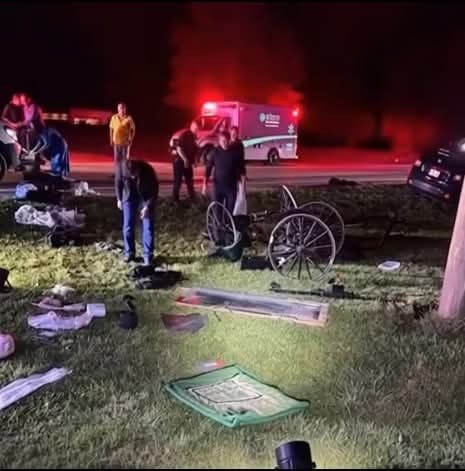
On a quiet stretch of State Road 218 outside Berne, a centuries-old way of life collided violently with the realities of modern traffic. Late at night, a horse-drawn Amish buggy carrying nine occupants was struck from behind by a Jeep, instantly transforming a routine journey into a scene of chaos and injury. The force of the impact shattered the wooden carriage, throwing passengers onto the roadway and leaving debris scattered across the asphalt.
Seven people were injured in the crash, the majority of them children. What moments earlier had been a peaceful ride home became a desperate emergency response. Helicopters landed nearby, their rotors cutting through the darkness, while flashing lights from ambulances and police vehicles illuminated the road. Sirens replaced silence, and a community accustomed to quiet evenings was confronted with sudden trauma.
Emergency responders worked quickly to stabilize the injured and transport them to nearby hospitals. Authorities later confirmed that several victims required advanced medical care, underscoring the vulnerability of those traveling in horse-drawn vehicles when struck by much heavier, faster-moving cars. Unlike modern vehicles, Amish buggies offer no structural protection—no seatbelts, no reinforced frames, no airbags—only wood, metal fittings, and reflective markings meant to alert drivers in time.
As investigators continue to reconstruct the moments leading up to the crash, attention has turned to the Jeep’s driver. Blood tests are being conducted as part of the investigation, and officials are examining whether speed, visibility, impairment, or inattention played a role. The outcome of those tests may help clarify responsibility, but for many in the area, the deeper questions extend far beyond this single incident.
How can fragile, slow-moving buggies safely share roads designed for steel, speed, and late-night traffic? Despite reflective triangles and lights, Amish buggies remain difficult to see, particularly after dark or on rural roads with limited lighting. Each year, similar accidents occur across parts of the Midwest, highlighting an ongoing tension between modern transportation and traditional lifestyles.
For the Amish community, the crash is more than a line in a police report. It is a painful reminder of the risks they face every day simply by traveling to visit family, attend gatherings, or return home after dark. Each curve in the road, each approaching set of headlights, now carries added weight. The memory of that single violent moment lingers—not just for the injured, but for an entire community forced once again to reckon with how vulnerable their way of life can be in a world that often moves too fast to notice them.
As recovery continues and the investigation unfolds, the incident has renewed calls for greater awareness, improved safety measures, and shared responsibility on rural roads. For now, however, the road outside Berne stands as a stark reminder of what can happen when two worlds meet without enough time, distance, or understanding to keep tragedy at bay.