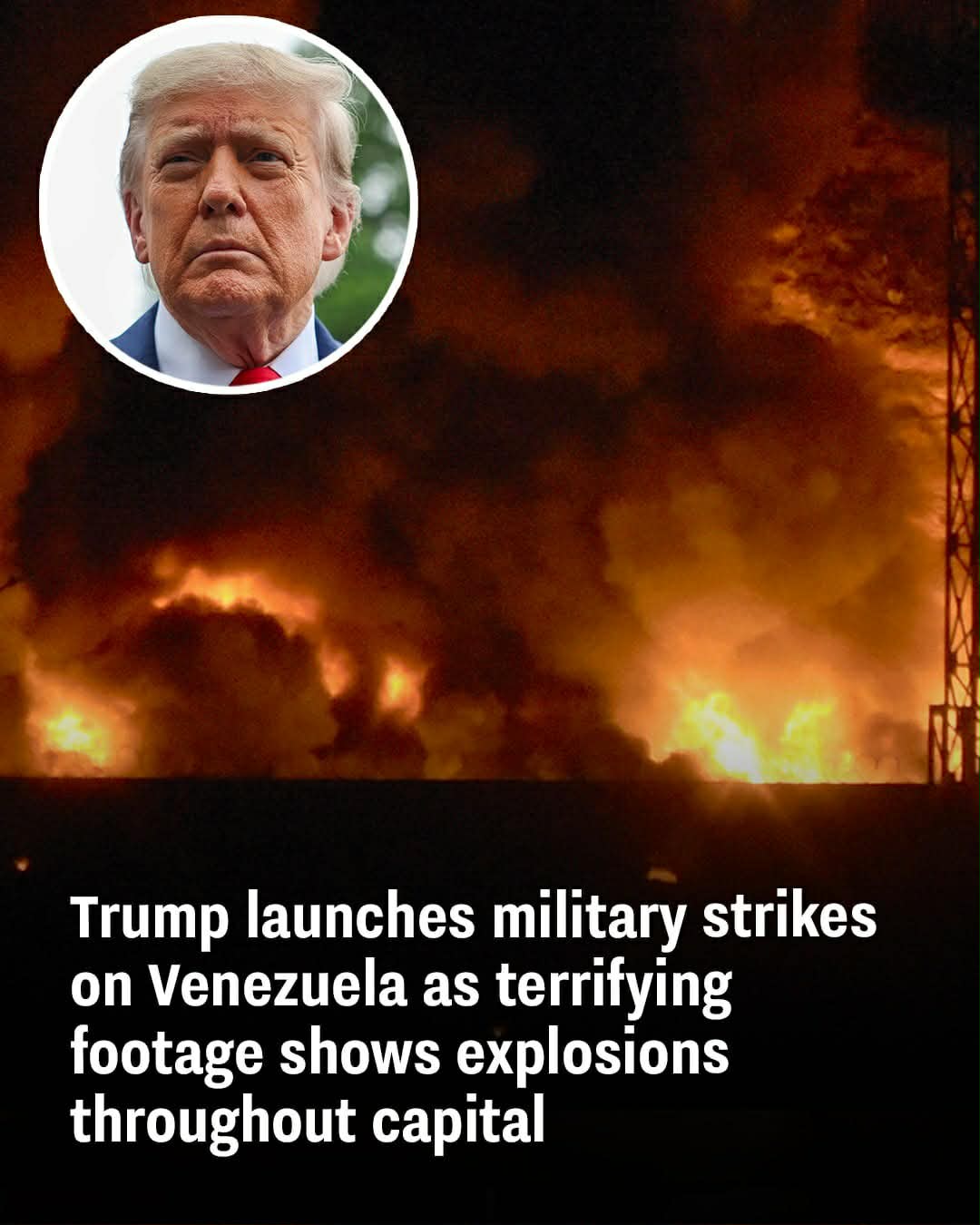
The first explosions struck before dawn, shattering the early-morning quiet over Caracas and immediately signaling that this was no routine military maneuver. Within hours, Donald Trump took to Truth Social, publicly boasting that Venezuela’s president had been captured and hinting that further details would soon follow from Mar-a-Lago. His posts, triumphant in tone, reverberated far beyond his online audience and into a region already on edge.
As the morning unfolded, residents of Caracas and nearby states reported violent tremors, burning military installations, and skies lit orange by fires and secondary explosions. Videos circulated rapidly, showing columns of smoke rising near strategic sites while civilians watched in shock from balconies and streets. What United States officials described as targeted “anti-narcotics” or “narco-terrorism” strikes were denounced by Venezuela as a direct act of aggression aimed at stripping the nation of its sovereignty, oil, and mineral wealth.
The operation marked a dramatic escalation. By striking military sites in and around the capital, Washington crossed a threshold that Venezuelan officials had warned about for years—direct attacks on core state infrastructure. Venezuelan authorities moved quickly to declare a national emergency, accusing the United States of using drug trafficking allegations as a pretext for regime change and resource seizure. State media framed the strikes as the opening salvo of a broader campaign, warning citizens to prepare for prolonged instability.
Trump’s public messaging only intensified those fears. His celebratory social-media posts, coupled with promises of more announcements to come, suggested an operation that might extend beyond a single night or a narrow mission. Critics warned that broadcasting triumphal claims in real time risked inflaming an already volatile situation and narrowing the space for de-escalation.
Regional reaction was swift. Cuba and Colombia both condemned the strikes, expressing alarm at the prospect of a conflict that could spill across borders and destabilize Latin America as a whole. Diplomats in the region warned that even limited military action against Venezuela could trigger refugee flows, economic shocks, and retaliatory moves by allied states.
The timing added another layer of complexity. Only months earlier, President Nicolás Maduro had floated the possibility of talks with Washington on oil production and cooperation against narcotics trafficking. Those overtures have now been overtaken by the language of survival and resistance. Venezuelan officials are speaking openly of invasion, “eternal war,” and national defense against a foreign power.
Caught between these competing narratives—Trump’s aggressive rhetoric and Venezuela’s warnings of existential threat—diplomacy appears increasingly distant. Analysts caution that once public positions harden and military assets are engaged, the risk of miscalculation rises sharply. For civilians in Caracas and beyond, the geopolitical arguments offer little comfort. What matters most is the uncertainty hanging over the coming days: whether the strikes mark the peak of a confrontation, or merely its beginning.
As night falls again over the capital, Venezuelans brace themselves, scanning the sky and waiting to see whether dawn will bring calm—or another round of fire from above.