Beneath the widely celebrated story of rapid growth and economic expansion in Arizona, a slower and far more dangerous emergency is taking shape—largely out of sight. For decades, underground aquifers acted as a natural buffer, quietly supplying water to cities, farms, and industries while stabilizing the land above them. Today, those reserves are being depleted far faster than nature can replenish them, setting off a chain reaction with permanent consequences.
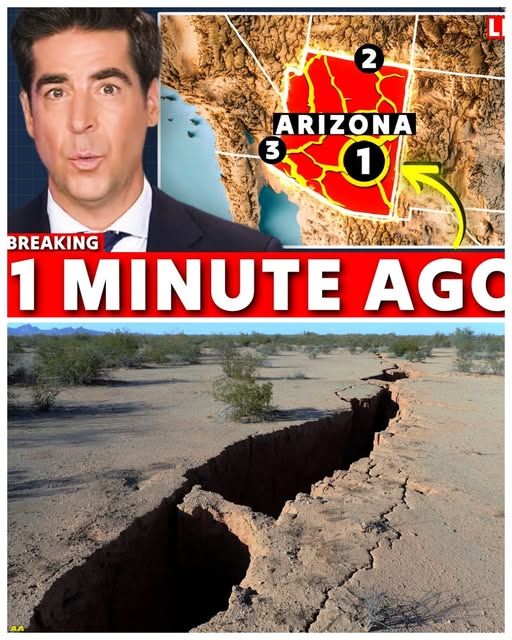
As groundwater levels drop, the sediments below the surface begin to compact. Once the water that supported them is gone, the ground itself starts to sink and shift. Over time, this compaction forces deep earth fissures to tear open across the landscape—long, jagged cracks that can stretch for miles. These are not minor surface flaws. They are structural ruptures that cut through farmland, residential neighborhoods, highways, canals, and buried utilities, transforming familiar places into zones of unpredictable danger.
In rural areas, fissures split agricultural fields, disrupt irrigation systems, and threaten livelihoods already strained by drought. In expanding suburbs, they can open beneath roads or near homes, undermining foundations and lowering property values. In some cases, fissures appear suddenly after heavy rain, when water rushes into weakened subsurface layers, widening cracks and accelerating collapse. The damage is often irreversible.
Scientists and geologists can monitor and map these fissures with increasing precision, using satellite data and ground surveys to track where the land is most vulnerable. What they cannot do is undo the damage once it occurs. When an aquifer collapses, its capacity to store water is permanently reduced. The support it once provided to the ground above is lost forever. No amount of rainfall can fully restore what has been compressed out of existence.
This reality leaves Arizona facing a stark and unavoidable choice. The state can adapt—by tightening groundwater regulations, rethinking where and how development occurs, and aligning growth with long-term water availability—or it can continue building on what experts describe as “borrowed ground.” That borrowed ground may hold for a while, but the bill is already coming due.
Policy plays a central role in determining the outcome. In some regions, groundwater pumping remains lightly regulated, allowing rapid development to outpace sustainable water use. Stronger rules, better regional planning, and a willingness to acknowledge that certain areas may no longer be safe or viable for large-scale development will be essential if communities are to endure. Avoiding these decisions only shifts the cost to future residents, taxpayers, and emergency responders.
The cracks spreading across Arizona’s deserts are more than geological features; they are warnings etched into the earth. They reveal the limits of growth in an arid environment and expose the consequences of treating groundwater as an endless resource. As fissures widen and multiply, they mirror deeper fractures in policy and planning—raising a fundamental question about how far the state can push its fragile landscape before it finally breaks.