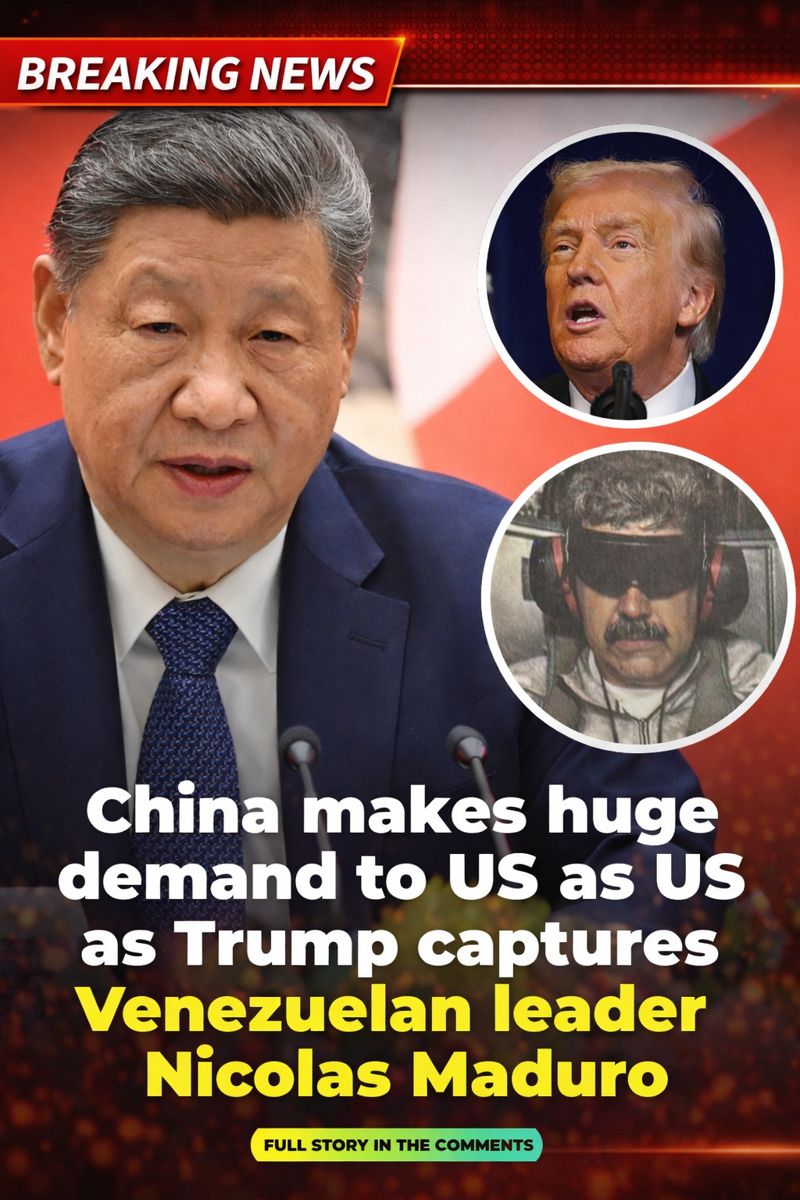
The world reacted with shock as reports emerged from Caracas that U.S. special operations forces had carried out a dramatic overnight raid, capturing Venezuela’s president Nicolás Maduro and extracting him under heavy military escort. Within hours, former U.S. president Donald Trump took to social media to declare that the United States was now “in charge of Venezuela,” framing the operation as a decisive assertion of American power and warning that further missions could follow if Caracas failed to “behave.”
What Washington portrayed as a bold and successful action immediately detonated into a global crisis. China issued an unusually sharp rebuke, condemning the raid as a violation of international law and accusing the United States of acting as a self-appointed “world police.” Beijing’s response went beyond diplomatic protest: it pushed for an emergency session of the United Nations Security Council, signaling that the confrontation had escalated from a regional shock to a test of the global order.
Chinese officials argued that Trump’s triumphant rhetoric—particularly his claim that America now “runs” Venezuela—evoked the language of an earlier era, one defined by gunboat diplomacy rather than international norms. For Beijing, and for many governments watching closely, the concern was not only the fate of Maduro, but the precedent such an operation sets: that a powerful state can unilaterally remove another country’s leader and openly threaten additional interventions.
That unease spread rapidly across Latin America and Europe. As Trump widened his rhetoric to include warnings aimed at Colombia, Cuba, and Mexico, regional leaders scrambled to contain the fallout. A rare joint statement from Brazil, Chile, Colombia, Mexico, Uruguay, and Spain warned that the raid struck at the heart of national sovereignty and created what they called an “extremely dangerous precedent.” The statement urged restraint, dialogue, and a recommitment to international law, reflecting fears that the operation could destabilize an already fragile region.
Despite the growing backlash, Trump continued to celebrate the raid as a “brilliant” success, dismissing criticism as weakness and portraying the operation as long-overdue accountability for a government he has repeatedly labeled criminal. His defiance has only sharpened the divide between Washington and much of the international community, as diplomats prepare for a contentious showdown at the United Nations.
Now, with an emergency Security Council session looming, Venezuela has become the focal point of a much larger struggle—one that goes far beyond Caracas. At stake is not only the future of a single country, but the question of who sets the rules in a world increasingly split between unilateral power and multilateral restraint. Between a triumphant White House and a mobilized global response led by Beijing, the crisis has exposed deep fractures in the international system, leaving the world bracing for what this new confrontation over global authority may unleash next.