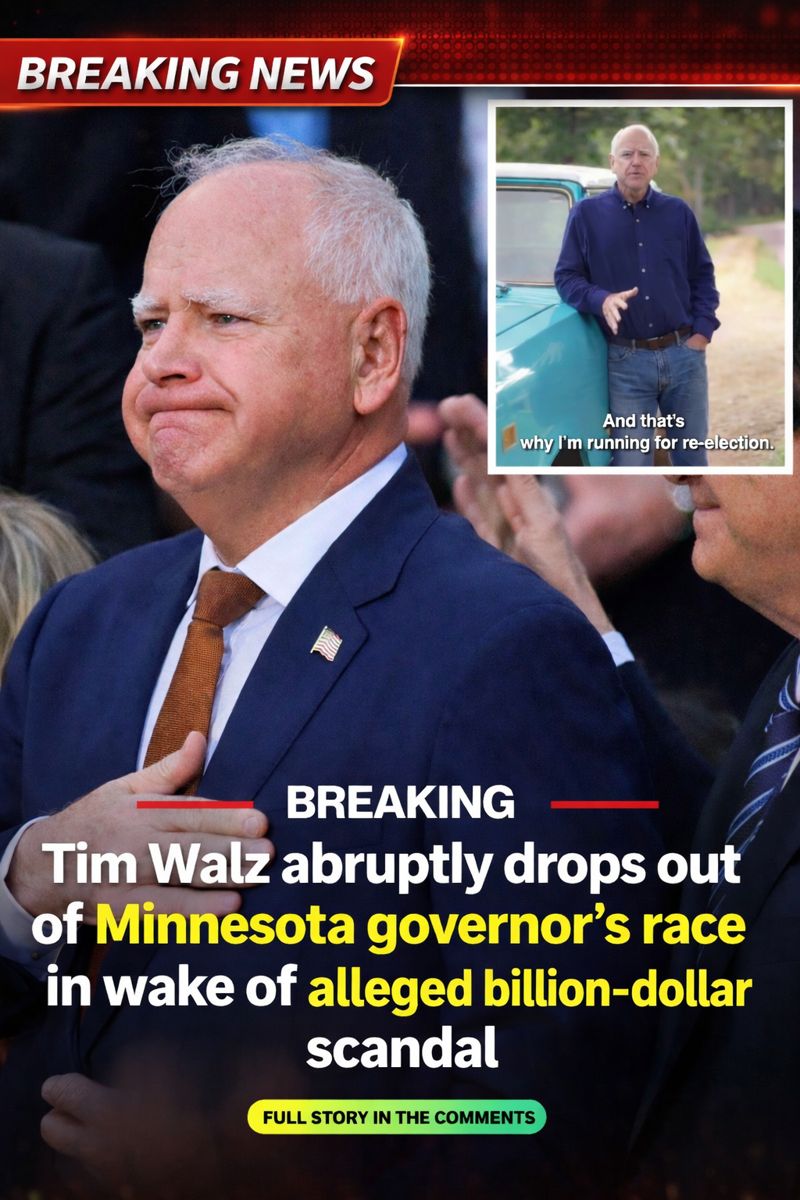
Governor Tim Walz’s decision not to seek a third term has abruptly shifted Minnesota politics from relative predictability into open uncertainty. What had long appeared to be a stable, blue-leaning landscape is now volatile, fractured, and dominated by a single unresolved question: was Walz’s exit an act of responsibility, or a strategic retreat from mounting political danger?
In announcing his decision, Walz cited an inability to “give a political campaign my all” while grappling with allegations of massive fraud that occurred under his administration’s watch. The phrasing was careful, even somber, but it left behind a lingering ambiguity. To critics, the move reads as a governor boxed in by scandal, choosing to step away before the full political cost becomes unavoidable. To supporters, it is framed as a rare display of restraint—a leader prioritizing accountability and governance over personal ambition.
What is undeniable is the impact of his departure. Walz’s exit instantly detonates a power vacuum at the top of state government. Allegations that billions of taxpayer dollars were misused or siphoned away have already eroded public trust, and his decision not to run again amplifies voter anger rather than calming it. For many Minnesotans, the question is no longer simply who will lead next, but how such alleged failures went unchecked for so long.
Behind the scenes, attention has quickly turned to Amy Klobuchar. Her name has begun circulating in political circles as a potential stabilizing force—someone with national stature, deep experience, and broad recognition who could step into the void. Whether she has any intention of doing so remains unclear, but the mere speculation underscores how unsettled the moment has become.
Meanwhile, Republican Party leaders see an opening rarely available in a state that has leaned Democratic for decades. With trust in state leadership shaken and voters openly frustrated, Republicans are positioning themselves to capitalize on the moment, framing the situation as evidence of systemic mismanagement and one-party complacency.
Walz’s political legacy, once anchored in stability, pragmatism, and a reputation for quiet competence, is now entering a far harsher phase of evaluation. Supporters point to his years of steady governance and crisis management. Critics argue that leadership is defined not only by what is handled well, but by what is missed—what wasn’t seen, what wasn’t stopped, and what wasn’t addressed quickly enough.
As Minnesota moves toward its next election cycle, Walz’s absence will loom large. His decision has not closed the chapter on controversy; it has widened it. The coming months will determine whether his exit is ultimately remembered as an act of accountability—or as the moment when a governor stepped aside while unanswered questions continued to multiply.