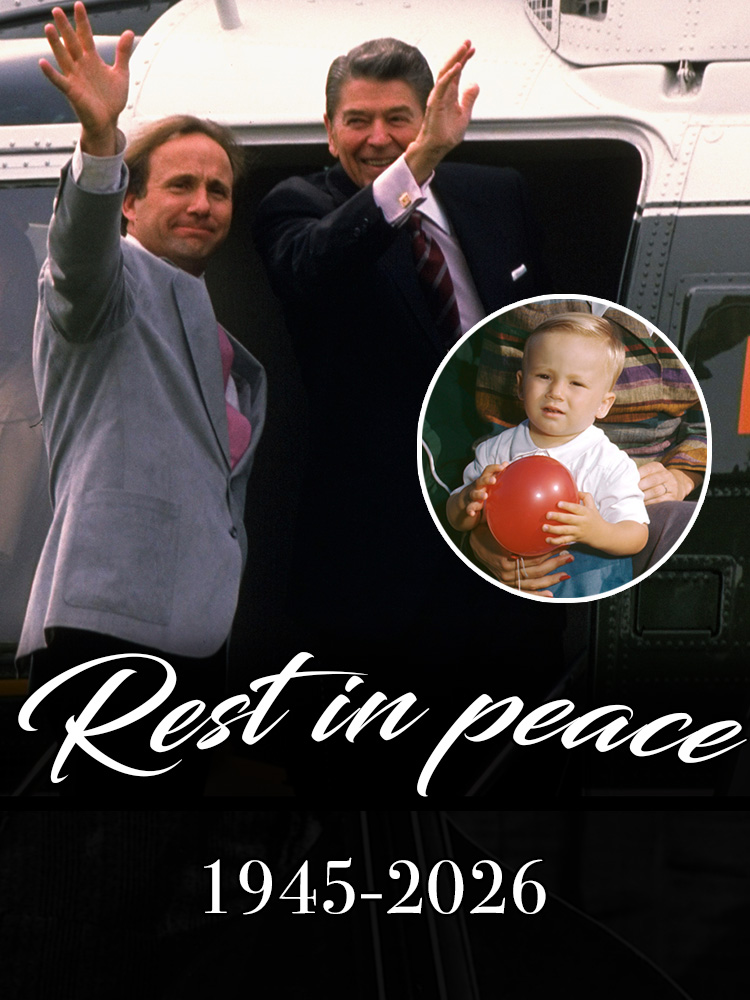
He entered the world as someone else’s child, then became “Reagan” within hours—a surname that carried extraordinary privilege, immense expectation, and a deep, often unspoken loneliness. Michael Reagan, adopted shortly after birth by Ronald Reagan and his first wife Jane Wyman, grew up in the shadow of one of the most commanding public figures of the twentieth century. From the outside, his life appeared charmed. From the inside, it was marked by a persistent struggle to feel truly seen.
As a child, Michael watched his father mesmerize audiences, command rooms, and inspire fierce loyalty. At home, however, the distance felt wider. He has spoken openly about learning he was adopted not from his parents, but from his sister—an early fracture that shaped his sense of identity and belonging. That feeling followed him into adulthood, reinforced by moments that cut deeply, including the day his father chose to attend another wedding instead of his own. For Michael, these were not isolated slights, but cumulative reminders that public duty often came before private connection.
The ache of growing up adjacent to greatness without feeling fully claimed left scars that no title or family name could erase. Yet those wounds were compounded by a far darker trauma. Years later, Michael would reveal that he had been sexually abused as a child—an experience he carried in silence for decades. Speaking about it publicly required confronting not only personal pain, but the stigma and disbelief that so often surround such disclosures, especially for men.
Rather than allowing that trauma to harden into bitterness, Michael chose a different path. His faith became a central framework through which he reinterpreted his life story. He has described himself as being “twice adopted”: once into the Reagan family, and again, spiritually, by God. That belief did not erase his suffering, but it gave it meaning—transforming shame into testimony and isolation into connection.
Over time, Michael Reagan reshaped his role in public life. Instead of defining himself by what he lacked, he leaned into what he could offer. He became a vocal advocate for his father’s legacy, not as an uncritical heir, but as someone who understood both the cost and the conviction behind Ronald Reagan’s public life. He raised money for charitable causes, spoke candidly about adoption, abuse, and forgiveness, and used his platform to give voice to experiences many endure quietly.
His story is not one of seamless reconciliation or sentimental resolution. The wounds did not vanish. The questions did not all receive answers. But Michael Reagan’s life illustrates something rarer and more durable than closure: growth. He chose to tell the truth about his pain without letting it consume him. He chose faith over resentment, purpose over grievance, and grace over silence.
In doing so, he carved out an identity distinct from the towering figure of his father—not as a footnote to history, but as a man who learned, slowly and deliberately, how to belong to himself.