In the grand architecture of the human body, few features are as expressive, functional, and scrutinized as a woman’s legs. While their primary purpose is undeniably utilitarian—carrying us through the world, facilitating movement, and providing a foundation for our physical presence—they have long occupied a central space in the cultural dialogue surrounding style, fitness, and identity. From the towering silhouettes on high-fashion runways to the powerful frames of elite athletes, the shape and stature of legs have quietly become a shorthand for interpreting lifestyle and personal presentation. While such observations often lean toward the playful rather than the clinical, they remain a source of endless fascination because legs serve as the body’s most visible blueprint of structure, strength, and genetic heritage.
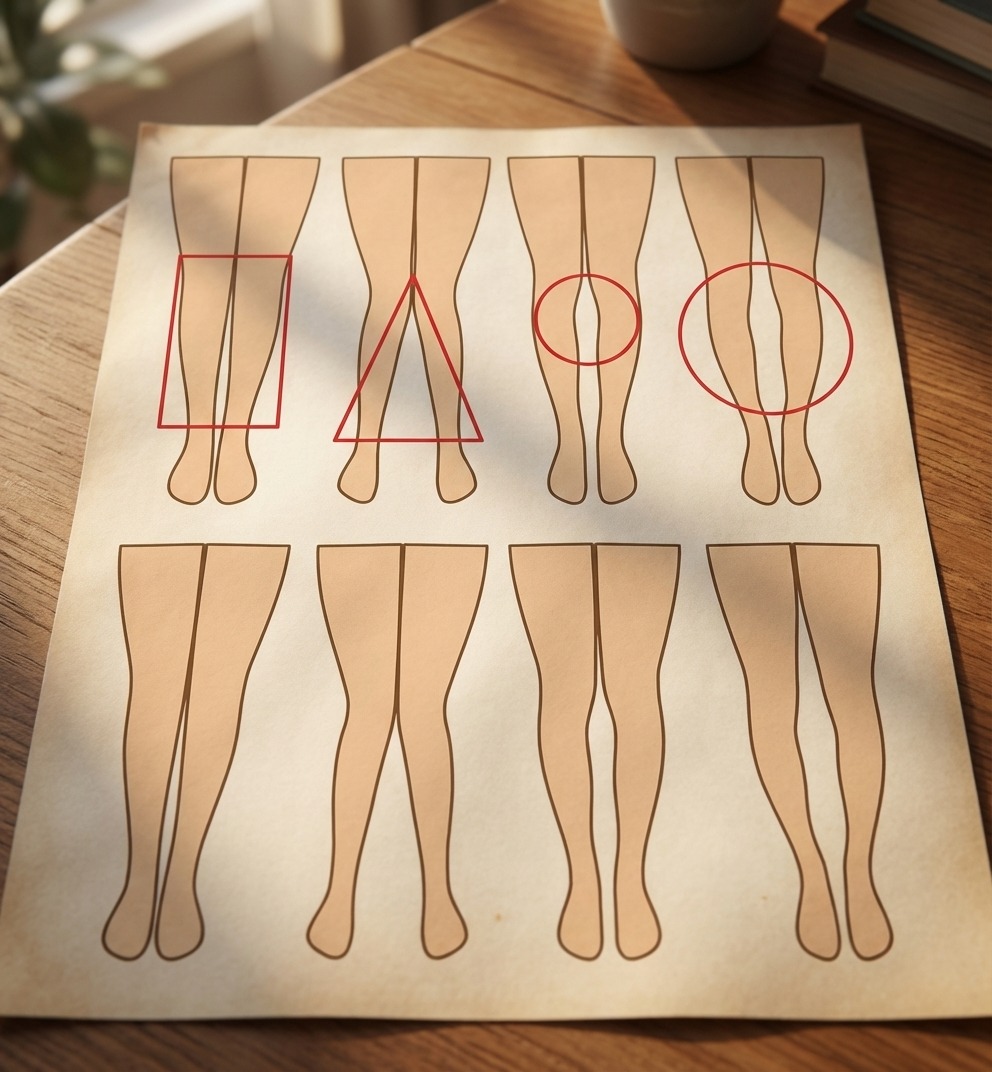
To understand what legs might “say” about a person, one must first appreciate the intricate dance of anatomy. The staggering diversity of leg shapes found across the globe is not merely a matter of habit or exercise, but a testament to the incredible variation in human bone structure and muscle placement. Genetics dictates the primary alignment of our limbs, determining the width of the pelvis and the angle at which the femur meets the hip. It is this fundamental framework that creates the various silhouettes we see in daily life. For instance, the widely discussed “diamond gap,” where the legs meet only at the ankles and knees, is often nothing more than a reflection of specific joint spacing. Similarly, the “thigh gap,” which has drifted in and out of cultural trend cycles for decades, is primarily a result of pelvic width and bone structure rather than a definitive marker of physical fitness.
Many common leg shapes are simply expressions of natural alignment. Straight, parallel legs are often aesthetically celebrated for their symmetry and balanced distribution of weight. From a movement perspective, this alignment suggests a centered center of gravity and a straightforward gait. In contrast, legs that feature a slight outward curvature or an inward angle at the knees are equally common and represent the body’s unique way of managing load and impact. These structural nuances influence everything from the way a person stands in a queue to the way they strike the ground while running. Rather than viewing these as “flaws,” modern style and wellness perspectives increasingly treat them as distinct characteristics that make each individual’s silhouette unique.
Because these physical traits are so closely tied to posture and movement, human nature has a tendency to project personality or lifestyle onto them in imaginative, non-scientific ways. In the realm of folk psychology and cultural observation, certain leg shapes are often associated with specific temperaments. A firm, parallel stance is frequently linked to a grounded and confident personality—a physical manifestation of a person who knows exactly where they stand. Conversely, a softer, more inward-leaning posture might be interpreted as a sign of a more relaxed, contemplative, or gentle approach to the world. Curvaceous legs, often associated with powerful muscle development, are frequently viewed as the mark of an energetic, active individual with a high-spirited stride. While these connections are far from medical facts, they reflect how we use the body’s “stature” to intuit the energy of those around us.
In the world of fashion, leg shape is the invisible hand that guides sartorial choices. Every person develops a subconscious understanding of how their specific anatomy interacts with fabric and form. Those with long, lean structures may gravitate toward tailored silhouettes that emphasize verticality, while individuals with more athletic or muscular builds might find their style home in wide-leg trousers or skirts that celebrate movement and volume. Style is, at its heart, a negotiation with one’s own frame. The way a woman chooses to dress her legs is often a reflection of her relationship with her body’s unique geometry. Some choose to highlight their strength with form-fitting athletic wear, while others prefer the flowing lines of drapery that soften the body’s angles. In this way, legs do not just tell a story of anatomy; they tell a story of self-perception and aesthetic preference.
The fitness world has further complicated and enriched the conversation around leg shape. While exercise cannot change the fundamental bone structure of a person’s limbs, it acts as a sculptor for the muscle that lives atop the bone. Different disciplines leave different “signatures” on the body. The powerful quadriceps of a cyclist, the elongated and lithe muscle tone of a dedicated yogi, and the explosive calf definition of a sprinter are all physical records of hours spent in pursuit of a goal. Here, the legs speak of discipline, endurance, and the specific types of challenges a woman chooses to set for herself. They become a living journal of her physical history, reflecting a preference for power, flexibility, or stamina.
However, the most important truth about a woman’s legs is that they are built for resilience rather than the fulfillment of a fleeting trend. The cultural obsession with symmetry and specific gaps often ignores the incredible mechanical complexity required for a human to walk upright. Our legs are marvels of engineering, containing the body’s largest bones and some of its most powerful muscles. What they truly reveal is a person’s capacity for support and adaptation. Whether a woman’s legs are short and sturdy, long and slender, bowed or straight, they are the pillars that hold up her world. They are the instruments of her autonomy, allowing her to claim space and move through the world with intent.
Ultimately, any discussion of what legs can “tell” you should begin and end with an appreciation for biological diversity. The various shapes and sizes we see are not verdicts on beauty or worth, but rather a reflection of a blueprint that has been refined over generations. A woman’s stature is a combination of her ancestors’ traits and her own lifestyle choices, creating a result that is entirely her own. When we move past the superficial desire for standardized ideals, we can begin to see leg shape for what it truly is: a fascinating intersection of heritage, habit, and health.
The story of a woman’s legs is, in the end, a story of movement. They tell us where she has been and how she chooses to carry herself into the future. They are the foundation of her posture, the engine of her travel, and the canvas for her personal style. By embracing the reality that strength comes in countless forms and that symmetry is less important than stability, we can appreciate the legs as they were meant to be seen—not as objects of scrutiny, but as the powerful, diverse, and capable limbs that move the world forward. Each pair of legs carries a unique narrative of strength and style, reminding us that the most beautiful way to stand is with comfort, confidence, and a deep appreciation for the body’s own singular design.