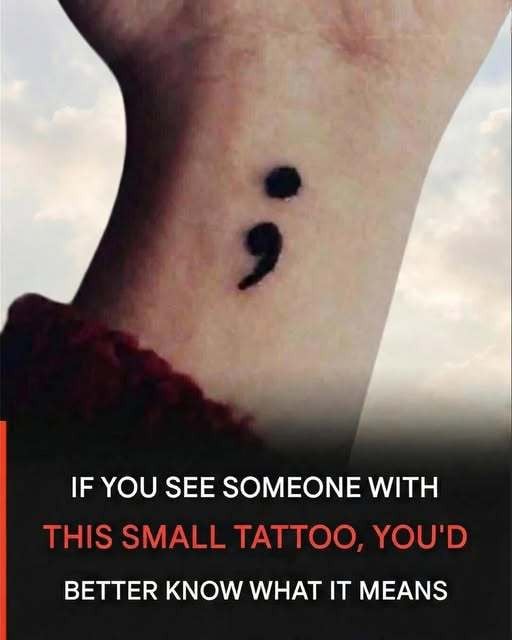
Beneath its simple and understated shape, the semicolon tattoo carries a meaning far deeper than its size suggests. For many people, it represents nights that were painfully endured, moments when reaching out for help felt impossible, and the courageous decision to continue when giving up seemed easier. What appears to be a small punctuation mark on the skin often symbolizes a powerful turning point — a quiet but determined refusal to let pain, despair, or struggle define the final chapter of one’s story.
The semicolon itself comes from writing, where it is used when a sentence could have ended, but the author chooses to continue instead. In the same way, the tattoo has become a global symbol for those who have faced mental health struggles, addiction, trauma, or suicidal thoughts and decided their story was not finished. For some, it marks the day they put down a bottle and began the difficult road to recovery. For others, it represents the moment they stepped back from a dangerous edge, made a call for help, or finally spoke words that had been buried in silence for years.
The meaning is deeply personal. Some wear the semicolon in memory of loved ones they lost — a permanent reminder of lives cut short and a promise to keep speaking openly about the struggles that too often remain hidden. Others carry it as a daily affirmation of resilience, a small symbol of survival that quietly acknowledges the battles fought behind closed doors. In a world where many people feel pressured to hide their pain, the semicolon stands as a subtle act of honesty.
What gives the symbol its true power is not decoration, but authenticity. It does not attempt to erase the darkness that came before it, nor does it pretend that healing is simple or complete. Instead, it recognizes that darkness exists while insisting that it does not have the final word. It represents the idea that life, even when broken or uncertain, can still move forward.
Occasionally, the symbol appears in unexpected places — on a wrist gripping a subway pole, on an ankle walking along a beach, or on the arm of a stranger passing by in a crowded street. In those quiet moments, it can feel like a silent acknowledgment between people who understand what it means to keep going when stopping seemed possible. No conversation is needed, only the shared understanding that survival itself is an act of courage.
In the end, the semicolon tattoo is more than ink. It is a message written on the body, a tiny curve and dot carrying a powerful declaration repeated every day without words: the story could have ended, but it didn’t. The sentence continues, and the person wearing it has chosen, again and again, to remain part of that unfinished story.