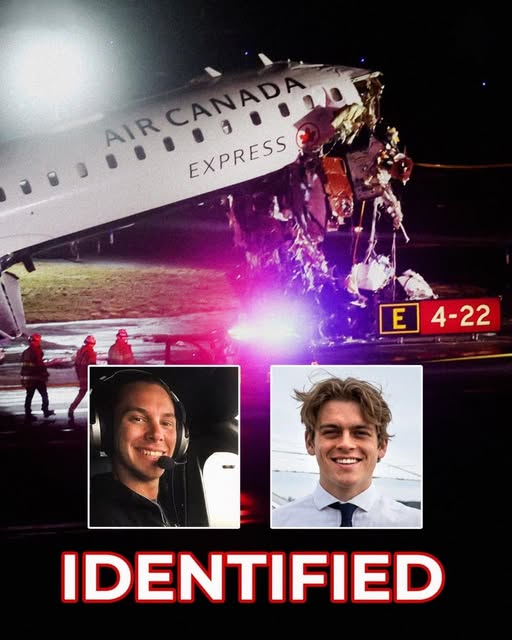
They never had a chance.
What began as a routine landing quickly escalated into a catastrophic sequence of events that would leave an airport in shock and cost lives within seconds. Two young pilots, operating under standard procedures, were moments away from completing what should have been an uneventful approach. Instead, they were confronted with a situation no crew is ever prepared to face — an unexpected obstacle on the runway, a fire truck that, under normal circumstances, should never have been in their path.
In the space of a few irreversible seconds, everything changed. The aircraft descended, systems responding as designed, until the moment reality diverged from expectation. The collision was sudden, violent, and unforgiving. Debris scattered, operations halted instantly, and across the radio frequencies, a quiet, haunting admission cut through the chaos: “I messed up.”
To most passengers onboard, the names Antoine Forest and Mackenzie Gunther meant little before that day. They were simply the professionals in the cockpit — voices over the intercom, unseen figures responsible for the journey. But in those final moments, they became something far more significant: the last line of control between order and disaster.
Both men brought different paths into that cockpit. Antoine Forest’s experience had been shaped in demanding environments — remote airstrips, unpredictable conditions, and the hands-on realities of aviation beyond major hubs. Mackenzie Gunther’s journey followed a more structured route, built through formal training, disciplined progression, and long hours of ground and ramp work. Despite their different beginnings, they shared the same foundation: a deep commitment to precision, responsibility, and the belief that preparation could overcome uncertainty.
When the situation deteriorated, that belief was all that remained.
Accounts from passengers who survived the incident paint a striking picture — not of chaos, but of control. There was no immediate sense of panic coming from the cockpit. Instead, there was a feeling, however fragile, that the pilots were still actively managing the situation, still working through options, still fighting to maintain command even as the aircraft lost stability and the runway environment turned into a scene of impact and motion.
Investigators will now undertake the meticulous process that follows every aviation accident. Data will be analyzed, timelines reconstructed, procedures examined in detail. Questions will be asked about communication, positioning, coordination, and how such a critical failure in ground operations could occur. Responsibility will be traced, and conclusions will eventually be drawn.
But for those who were there — those who experienced the final moments from inside the cabin — the memory will not be defined solely by reports or technical findings.
It will be defined by the human element.
By the understanding that, when every system around them failed and the margin for recovery disappeared, two pilots remained at their posts, continuing to act, to decide, and to try — right up until the very end.
And in that effort, however brief and however tragic the outcome, they left behind something that no investigation report can fully capture: the enduring image of professionals doing their duty in the face of the impossible.