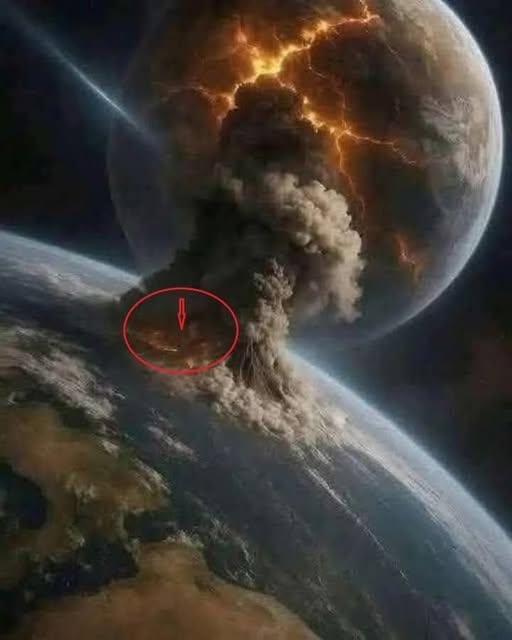
Social media erupted after a dramatic image began circulating online alongside alarming claims that “breaking news” confirmed Earth would experience a catastrophic event on December 27. Within hours, the post spread rapidly across multiple platforms, fueled by fiery visuals, urgent language, and vague references to unnamed “sources” supposedly withholding critical information from the public.
The image itself appeared designed to provoke immediate fear.
It showed a cinematic vision of Earth seemingly cracking apart and exploding from within, surrounded by glowing fractures and apocalyptic destruction. Combined with ominous captions and a precise date, the post created a sense of urgency that many viewers found difficult to ignore. For some, the image looked convincing enough to trigger genuine concern.
Questions quickly flooded comment sections and social media feeds.
Had scientists detected an incoming asteroid?
Was Earth experiencing some internal rupture?
Had space agencies discovered a hidden threat they were not revealing?
The specific date attached to the claim only intensified the reaction. Unlike vague predictions that speak about distant or uncertain dangers, a fixed deadline creates emotional pressure. It transforms speculation into something that feels immediate and personal, encouraging rapid sharing before facts can be checked.
Yet the reality behind the viral image is far less dramatic—and far more revealing about the way misinformation spreads online.
The image circulating with these claims was not a real photograph of Earth, nor was it connected to any scientific discovery or official warning. It was a piece of digital artwork that has existed online for years, appearing across science-fiction communities, concept-art galleries, and more recently within collections of AI-generated imagery.
Its purpose was visual storytelling, not scientific documentation.
No space agency, observatory, or research institution issued any statement warning that Earth would “begin breaking,” explode, shift, or collide with another object on December 27 or any other scheduled date. Despite the confident language used in viral posts, no supporting evidence accompanied the claims.
This distinction matters.
Real scientific discoveries involving planetary threats do not emerge through anonymous captions or dramatic graphics shared without context. They are supported by data, peer review, public statements, and independent verification from multiple organizations.
Experts have repeatedly explained that events capable of threatening Earth on a catastrophic scale would not appear suddenly or remain hidden.
Massive asteroid impacts, for example, are among the most closely monitored risks in modern astronomy. International agencies continuously track near-Earth objects using advanced telescopes and detection systems designed to identify potential hazards years—and often decades—in advance.
Likewise, theories involving internal planetary collapse or sudden geological destruction are not supported by current scientific understanding.
Earth is a dynamic planet with tectonic movement, volcanic systems, and natural geological processes, but there is no known mechanism suggesting that the planet could suddenly begin “breaking apart” without extensive warning signs and global scientific attention.
Organizations such as NASA, the European Space Agency, and independent observatories around the world maintain continuous monitoring of space activity and planetary conditions.
Had any credible anomaly been detected, it would not remain confined to rumor or anonymous posts.
It would be publicly documented and internationally discussed.
No such warning exists.
No alert has been issued.
No hidden discovery is being suppressed.
Instead, the viral post relied on something far more powerful than evidence:
Emotion.
The psychology behind these posts is remarkably consistent.
They combine dramatic visuals, uncertainty, and urgency into a formula designed to capture attention before skepticism has time to develop. A striking image draws the eye. Vague wording creates mystery. A specific date introduces pressure and anxiety. Additional elements—such as arrows, red circles, or phrases implying secrecy—encourage viewers to believe they are witnessing information others supposedly want hidden.
This formula spreads quickly because it targets instinct rather than analysis.
Fear moves faster than verification.
People naturally react to potential danger, especially when presented in emotionally charged formats. Sharing becomes an immediate response—not necessarily because the information is trusted, but because the possibility feels too alarming to ignore.
Yet when these claims are examined carefully, a familiar pattern emerges.
No named experts.
No scientific papers.
No measurable data.
No verifiable sources.
Only recycled images paired with recycled fear.
December 27, like countless dates attached to viral predictions before it, is expected to arrive and pass like any ordinary day, with Earth continuing the same orbital and geological processes that have sustained it for billions of years.
The broader lesson extends beyond one misleading image.
This incident serves as another reminder of how easily misinformation can flourish in digital spaces where emotional content often outpaces factual reporting. The speed of online sharing rewards urgency, while truth usually requires patience, context, and verification.
Real scientific discoveries rarely appear first through blurry graphics or anonymous warnings.
They come through evidence.
They come through transparency.
And they are confirmed through global scrutiny rather than viral speculation.
Fear spreads quickly online.
Facts move more slowly.
But facts remain the stronger foundation—and they matter far more than panic ever will.