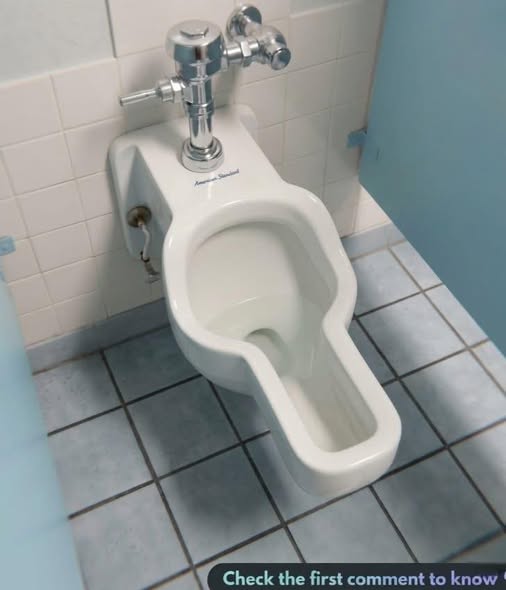
In a place best known for celebrating engineering, innovation, and the history of space exploration, one of the most unexpected conversations may be unfolding not around rockets or technology—but inside the restroom.
The U.S. Space & Rocket Center’s decision to introduce women’s urinals has attracted public attention and sparked discussion that reaches far beyond the appearance of a single restroom fixture. While some reactions have focused on novelty or surprise, the larger conversation centers on something far more practical: whether traditional restroom design has truly reflected the needs, comfort, and efficiency of all users.
For decades, public restroom layouts have largely followed familiar standards that many people rarely question. Yet those standards have often produced noticeably different experiences. Long waiting lines outside women’s restrooms, overcrowded stalls, and limited availability during busy events have become so common that many accept them as unavoidable parts of public life.
This normalization, however, raises an important question:
Were these inconveniences ever inevitable—or were they simply built into systems that were never fully designed around women’s experiences?
The introduction of standing or semi-standing restroom options represents an attempt to reconsider that assumption.
Rather than being driven by shock value or novelty alone, supporters argue that the concept addresses practical concerns that have long shaped restroom accessibility and efficiency. These fixtures are designed to offer an alternative method of use that may reduce physical contact with shared surfaces, increase restroom turnover during crowded periods, and potentially improve convenience for some users.
At its core, the conversation is less about replacing traditional facilities and more about expanding available choices.
Public infrastructure often evolves slowly, particularly when linked to habits and social expectations that feel deeply familiar. Yet history shows that many features people now consider standard—from accessibility ramps to family restrooms and touch-free technology—were once viewed as unusual or unnecessary before broader acceptance followed.
The Space & Rocket Center’s decision reflects this larger pattern of experimentation and adaptation.
Beyond questions of convenience, the initiative also intersects with growing interest in environmental sustainability and resource management. Water conservation remains an increasingly important consideration in public infrastructure planning, and certain alternative restroom technologies are designed to use less water than conventional systems.
For institutions managing large public spaces and significant visitor traffic, even small improvements in efficiency can translate into meaningful reductions in water consumption and operational demand over time.
This introduces another layer to the discussion:
Restroom design is not merely a matter of architecture or comfort. It is also tied to environmental responsibility, maintenance considerations, and how institutions allocate resources to serve the public more effectively.
Advocates suggest that redesigning public facilities through this broader lens reflects a more serious approach to infrastructure—one that acknowledges restrooms as essential public systems rather than overlooked necessities.
At the same time, acceptance of any unfamiliar design depends on more than functionality alone.
Privacy, clarity, and user comfort remain central to whether new concepts succeed. Public response often depends on how thoughtfully changes are introduced and whether people feel their preferences and boundaries are respected. Clear instructions, intuitive layouts, and careful attention to privacy standards will likely play an important role in shaping public opinion.
Cultural familiarity also matters.
Many innovations encounter hesitation not because they are ineffective, but because they challenge routines that people have followed for generations. Adapting to unfamiliar designs often requires time, open discussion, and a willingness to reconsider assumptions that once felt fixed.
That reality places this conversation within a broader social context.
The debate surrounding women’s urinals is not solely about plumbing or architecture. It reflects ongoing discussions about inclusion, infrastructure equity, and whether public spaces should evolve to better accommodate diverse experiences and practical needs.
Some will view the concept as unnecessary or unconventional.
Others may see it as a logical response to long-standing frustrations surrounding restroom accessibility and efficiency.
Either way, the discussion itself signals something meaningful: a growing recognition that even the most ordinary spaces deserve thoughtful design and periodic reevaluation.
If the initiative proves effective, its significance may extend beyond one institution or one unusual-looking fixture.
It could become a reminder that progress is not always dramatic or technological in the traditional sense. Sometimes innovation appears in unexpected places—in the overlooked details of daily life where comfort, time, and dignity quietly intersect.
And perhaps that is what makes this development notable.
Not because it seeks attention, but because it asks a simple question that public design has not always answered equally:
Could everyday spaces work better for everyone if we were willing to rethink what we once accepted as standard?