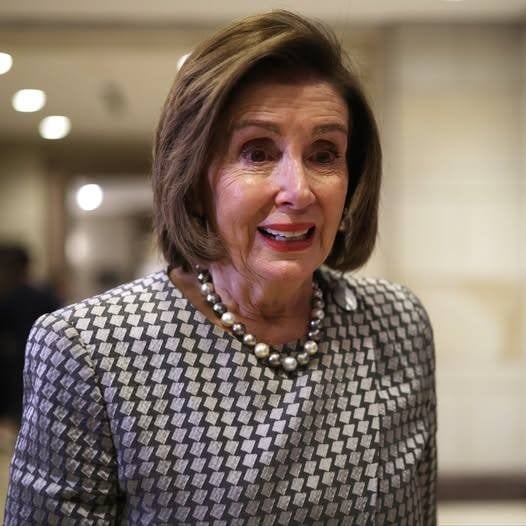
In Luxembourg, far from the familiar halls of the U.S. Capitol that defined much of her political life, Nancy Pelosi now finds herself in a moment where public service meets personal limitation in a way that no legislative vote or political negotiation can delay.
During a commemorative event marking the Battle of the Bulge, a ceremony intended to honor history and sacrifice, an unexpected fall disrupted what had been a carefully structured moment of remembrance. What was meant to be a symbolic tribute instead became an unplanned test of endurance and recovery, shifting attention from ceremony to concern within seconds.
According to accounts from those present and close to the situation, the immediate response was not marked by alarm, but by composure and focus. Even in the aftermath of the incident, attention reportedly turned toward practical matters—staff coordination, schedule adjustments, and ongoing briefings—reflecting a long-established pattern of continued engagement even under physical strain.
That detail has not gone unnoticed.
Throughout her career, Pelosi has been widely associated with persistence and political stamina, often described by supporters and critics alike as a figure capable of sustaining intensity across decades of legislative battles, leadership transitions, and national crises. In this context, the current hospitalization represents not an interruption of relevance, but a temporary pause in an unusually long and active public trajectory.
Following the incident, messages of concern and support were reportedly shared across political and international lines. Figures from both major U.S. parties, as well as European officials and NATO representatives, expressed well wishes during her recovery. The tone of those responses reflected an uncommon point of agreement in modern politics: recognition of the endurance required to remain a central figure in public life over such an extended period of time.
While political perspectives on her legacy remain deeply divided, there is broad acknowledgment that her presence has significantly shaped legislative outcomes, institutional dynamics, and political strategy over multiple decades. Her role in American governance has been defined not only by policy positions, but also by longevity and consistency in high-pressure environments.
As medical teams continue to monitor her condition, the events she traveled to attend proceed as planned, continuing the commemorative focus on resilience, sacrifice, and historical memory. In an ironic parallel, the themes being honored in Luxembourg echo aspects of the situation unfolding in real time: endurance in the face of physical and historical weight.
For those observing closely, this moment is being interpreted less as a conclusion and more as a pause within a much larger continuum. Political careers of this scale are often measured not only by milestones achieved, but by the ability to remain present through shifting eras, challenges, and expectations.
In that sense, the current situation underscores a broader reality of public life at its highest levels: even the most sustained careers eventually intersect with human limits.
And yet, as her recovery continues, the narrative surrounding her remains consistent with the one that has followed her for decades—one defined by persistence, duty, and the expectation of return, even after interruption.