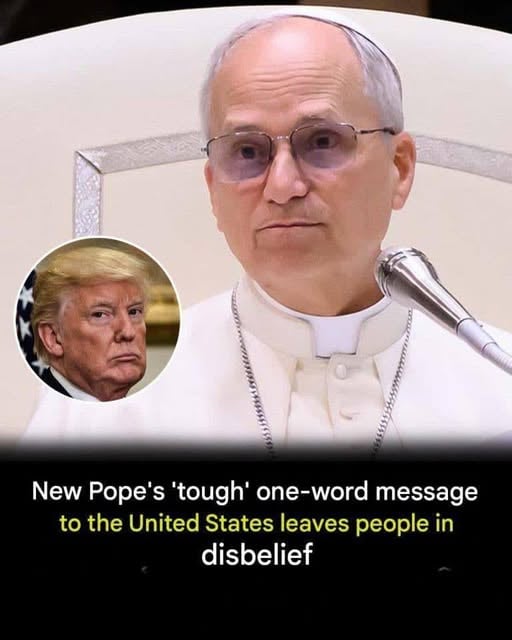
Just days after the beginning of his papacy, Pope Leo XIV found himself at the center of international attention—not because of a formal decree or major policy announcement, but because of a brief exchange that quickly spread across social media and news platforms worldwide.
During a press conference held on May 12, a journalist asked the Chicago-born pontiff a seemingly straightforward question: whether he had a message for the United States.
His response was unexpectedly concise.
Pope Leo XIV paused for a moment, smiled, and replied with a single word:
“Many.”
He then added calmly, “God bless you all.”
The exchange lasted only seconds, yet its impact extended far beyond the room.
Almost immediately, the clip began circulating online, drawing intense public discussion and a wide range of interpretations. Some viewers described the response as cryptic or unusually loaded with meaning, while others praised its restraint, viewing it as a measured and thoughtful answer from a newly elected spiritual leader navigating global attention.
Part of the fascination surrounding the moment stems from the Pope’s public record and the broader context surrounding his leadership.
Before ascending to the papacy, Pope Leo XIV had already developed a reputation for engaging with social and political issues through a moral rather than strictly partisan lens. His comments on immigration, economic inequality, and human dignity often reflected concern for vulnerable populations while avoiding rigid alignment with any political faction.
Because of this history, many observers interpreted his single-word answer not as evasive, but as intentionally open-ended.
For some, “many” suggested concern, reflection, or perhaps acknowledgment of the complexity surrounding social and political tensions affecting the United States. Others viewed it as a reminder that no single sentence could fully capture the challenges or hopes connected to a nation facing deep cultural and political divisions.
The ambiguity itself became part of the story.
Rather than offering a headline-ready declaration, Pope Leo XIV left space for interpretation—a style of communication that some supporters argue reflects pastoral caution and diplomatic awareness rather than political calculation.
His public positions over the years help explain why the moment resonated so widely.
The Pope has previously expressed criticism of certain immigration policies associated with the Trump era, particularly where issues of family separation, refugee treatment, or humanitarian concerns were involved. At the same time, he has also shown willingness to question aspects of progressive political agendas, particularly when discussions touch on ethical, moral, or human dignity concerns.
This has contributed to an image of a pontiff who resists easy political categorization.
Rather than positioning himself firmly within traditional partisan frameworks, Pope Leo XIV appears to favor a broader approach rooted in compassion, social responsibility, and moral consistency—an approach that appeals to some while inviting scrutiny from others.
His choice of papal name carries symbolic significance as well.
By choosing the name Leo XIV, he invokes the legacy of Pope Leo XIII, widely remembered for championing workers’ rights and addressing economic inequality during a period of major social transformation. That historical connection has led many Vatican observers to view the new Pope’s priorities as similarly focused on dignity, fairness, labor concerns, and social justice.
In this context, the viral moment takes on added meaning.
What appeared at first to be a simple exchange became, for many, an early glimpse into the communication style and leadership approach of a new pontiff still defining his public voice.
Some interpreted his answer as subtle diplomacy.
Others saw moral concern.
And some simply appreciated the humility of refusing to reduce complicated realities into easy slogans.
Whatever interpretation people choose, the response achieved something increasingly rare in public discourse: it prompted conversation without escalating division.
As Pope Leo XIV settles into the early days of his papacy, moments like this will likely continue to be closely examined—not only for what they say directly, but for what they may suggest about the priorities and tone of his leadership moving forward.
For now, one thing remains clear:
A single word was enough to capture global attention—and remind people that sometimes the shortest answers generate the longest conversations.