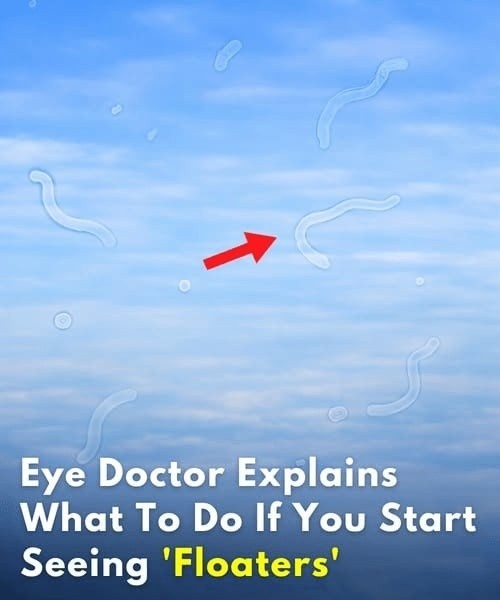
Those small drifting specks, thread-like shadows, or cobweb shapes moving across your vision can feel unsettling, especially when they appear unexpectedly or seem more noticeable than before. Many people first notice them while looking at a bright sky, a white wall, or a computer screen, where the movement becomes impossible to ignore. The instinctive reaction is often concern—wondering whether these strange shapes signal something serious or simply reflect a normal part of aging.
In many cases, these visual disturbances, commonly known as eye floaters, are not dangerous.
They are often the result of natural changes occurring inside the eye over time. The vitreous, a gel-like substance filling the center of the eye, gradually changes with age. As this transparent gel slowly shrinks and becomes less uniform, tiny clumps or strands can form within it. When light passes through the eye, these particles cast shadows onto the retina, creating the drifting shapes many people describe as dots, strings, or floating webs.
For countless individuals, floaters become little more than an occasional distraction.
The brain frequently learns to ignore them, allowing them to fade into the background of everyday life. They may appear more clearly in certain lighting conditions but often remain harmless and stable over time. Aging, nearsightedness, previous eye surgery, or natural vitreous changes are among the most common reasons they develop.
Yet while many floaters are benign, the difference between a harmless nuisance and a serious medical warning can sometimes be surprisingly narrow.
This is why changes in vision deserve careful attention rather than assumption.
Eye specialists emphasize that a sudden increase in floaters should never be dismissed casually. A rapid “storm” of new specks, particularly when accompanied by flashes of light or altered vision, may point to something far more significant occurring inside the eye.
Those lightning-like flashes are especially important to recognize.
They can occur when the vitreous pulls against the retina—the delicate, light-sensitive tissue lining the back of the eye that makes vision possible. In some cases, this traction may create small retinal tears. If untreated, those tears can progress into retinal detachment, a serious medical emergency that threatens permanent vision loss.
Another warning sign involves the appearance of shadows or darkness.
Many people describe it as a curtain, veil, or creeping shadow entering part of their field of vision. Others notice blurred edges or missing areas of sight that seem to expand over time. These symptoms should never be viewed as inconveniences or temporary annoyances to “wait out.”
The danger lies not only in the symptoms themselves but in delay.
When changes affecting the retina are identified early, treatment is often highly effective and can preserve vision. However, postponing medical attention in the hope that symptoms will simply disappear may allow damage to progress silently.
This is why eye doctors consistently stress the importance of prompt evaluation when vision changes occur suddenly.
An eye examination can determine whether the retina remains safely attached or whether intervention is needed to prevent permanent harm. The exam itself may provide reassurance—or it may identify a problem while there is still valuable time to act.
Modern life often encourages self-diagnosis.
People naturally search symptoms online, compare experiences, or convince themselves that unusual changes are probably harmless. But eyesight is uniquely precious and remarkably fragile. Unlike many minor health concerns that can safely be observed at home, sudden visual symptoms deserve professional assessment.
The message is not one of fear, but awareness.
Most floaters are ordinary signs of the eye changing over time. But knowing when ordinary becomes urgent is what truly matters. Paying attention to subtle shifts in vision and responding quickly when warning signs appear can make an enormous difference.
Sometimes a prompt examination confirms nothing more than a temporary scare.
Other times, it protects something impossible to replace.
Your eyesight carries every face, place, and moment you experience. Listening carefully when it changes is not overreacting—it is protecting one of your most valuable senses before silence turns into loss.