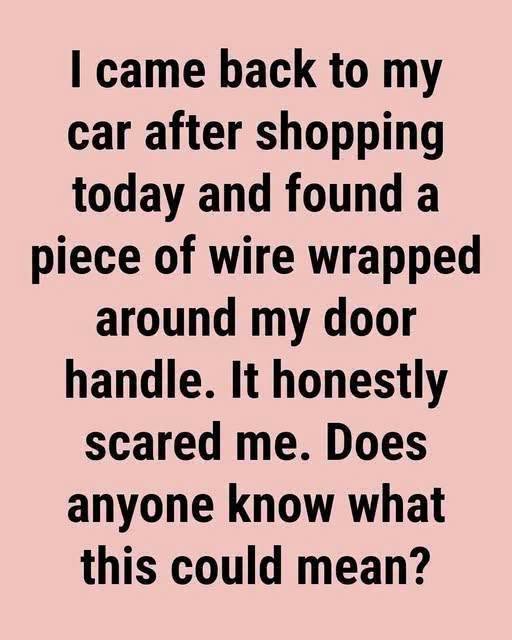
You walk toward your vehicle in the flickering shadows of a deserted parking garage, keys clutched tightly in your sweating palm, when you notice something that stops your heart mid-beat. A thin, brightly colored wire is knotted with surgical precision around your door handle. This isn’t a random accident; it is deliberate, calculated, and deeply, viscerally unsettling. As you scan the dark rows of surrounding cars, you realize with a jolt of pure terror that you aren’t the only one targeted. A dozen other vehicles share the same eerie, unexplained mark—and the hunter could be watching you right now.
This terrifying scenario recently went viral after a TikTok user named Shannon shared her experience, igniting a wildfire of speculation and genuine fear across the internet. In our hyper-connected age, where digital platforms amplify our deepest, most primal anxieties, the discovery of these markers quickly transcended a simple observations. Was this merely a harmless prank, a quirky local festival marker, or something far more sinister? Within hours, social media comment sections were flooded with a chaotic mix of theories, ranging from the mundane to the absolutely bone-chilling. Many users were instantly convinced these were tactical “markers” used by criminals to identify vulnerable targets, while others whispered about complex, predatory schemes designed to force drivers to pause, creating a lethal window of opportunity for an ambush.
The narrative gained dangerous momentum when another creator, Reese, provided a perspective that made the threat feel all too real. The theory posits that these objects—whether they are zip ties, wires, or ribbons—function as psychological traps. By introducing a startling anomaly into an otherwise routine environment, a predator forces the victim to stop, inspect, and attempt to remove the object. In that brief, critical moment of distraction, the victim’s situational awareness vanishes, their back is turned, and their guard is completely down. For a generation already hyper-aware of the hidden dangers lurking in public spaces, this explanation didn’t feel like a mere rumor; it felt like a direct, life-saving warning to keep moving.
However, the rapid transition from online speculation to widespread real-world panic is a treacherous path. As the video circulated further, reaching millions of viewers who were already on edge, law enforcement agencies began to issue statements pushing back against the growing hysteria. Despite the intensity of the fear being shared, there remains zero verified evidence linking these specific ribbons or wires to organized crime, human trafficking rings, or targeted kidnappings. Authorities have repeatedly noted that viral warnings involving “secret criminal markings” are almost always unsubstantiated, often born from a strange combination of pure coincidence, urban legend, and the innate human tendency to desperately find patterns in chaos.
The reality of the modern era is that our digital feeds are fundamentally designed to prioritize viral engagement over objective accuracy. A video that confirms our worst fears, triggers our fight-or-flight response, and encourages us to share “warning” content with our loved ones is far more likely to go viral than a dry, factual, and reassuring statement from a local police department. This incident serves as a potent, sobering reminder of the power of the narrative. When we encounter something unusual, our strongest instinct is to protect ourselves and our families, but that instinct can be easily weaponized by algorithms that profit from our collective unease and paranoia.
Ultimately, the most important takeaway from this phenomenon is not the existence of the wire itself, but the vital necessity of maintaining a balanced, rational perspective in a world that thrives on misinformation. Vigilance is undoubtedly a virtue; it is the cornerstone of personal safety. However, when vigilance curdles into constant, suffocating paranoia, it becomes a trap in itself. While you should always be mindful of your surroundings and trust your gut if a specific situation feels genuinely threatening, it is equally vital to distinguish between a legitimate security risk and the loud, frantic echoes of internet-fueled anxiety.
If you ever encounter something truly suspicious on your vehicle or in your vicinity, the absolute best course of action is to report it to the proper authorities rather than feeding the cycle of online panic. Take a photo, contact your local police station, and move on. Do not linger to investigate, do not engage with the potential mystery, and certainly do not jeopardize your safety for the sake of an online theory. Stay safe, stay alert, and remember that while the world can be a dangerous place, not every strange shadow in a parking lot is a monster waiting to strike. By grounding ourselves in reality, we can protect ourselves from both physical threats and the psychological toll of digital fear-mongering.