October 27, 2026
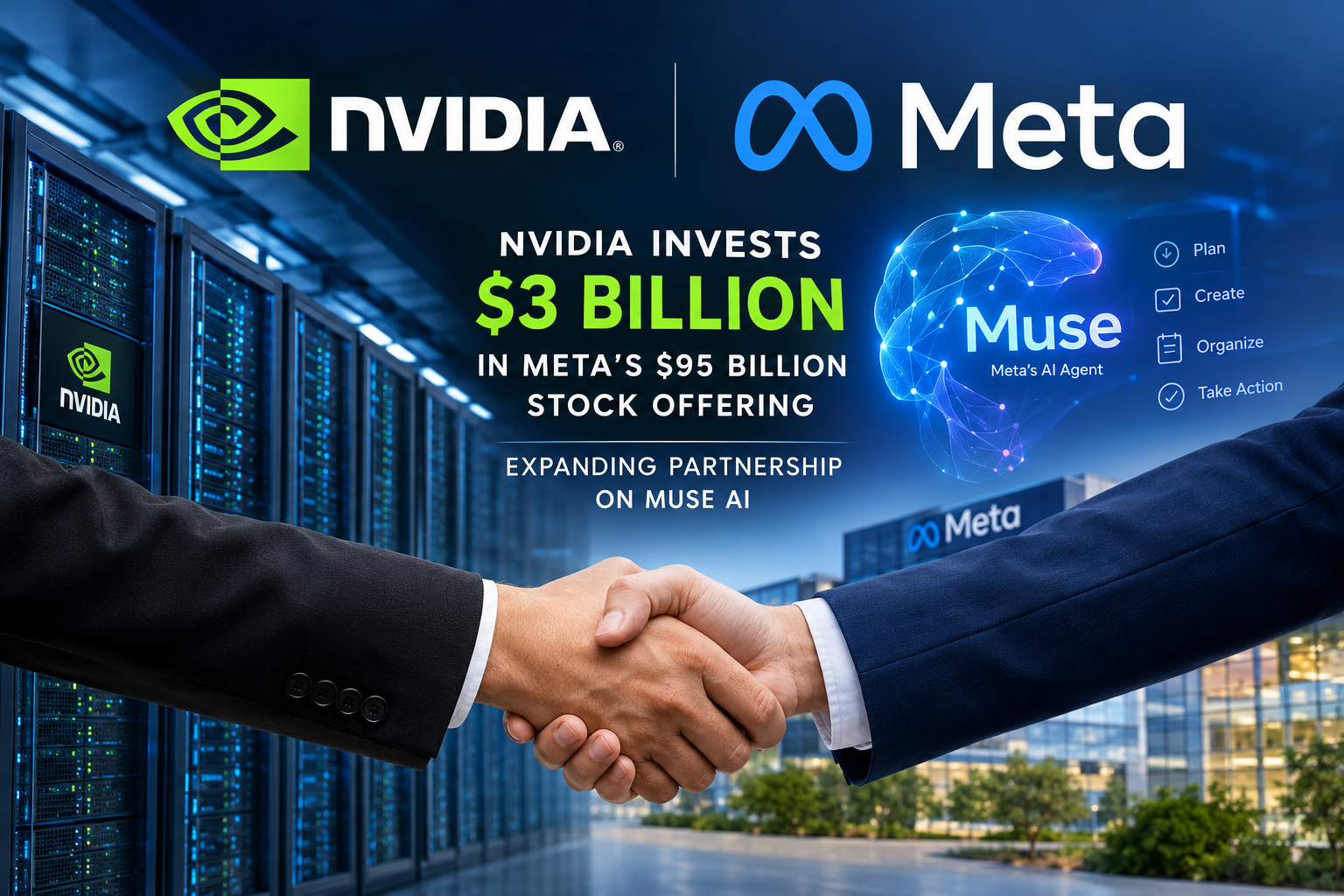
Nvidia has agreed to invest $3 billion in Meta Platforms as part of the social media giant’s planned $95 billion stock offering, strengthening the partnership between two of the world’s most influential technology companies. The investment comes as both companies expand their collaboration on artificial intelligence (AI), particularly Meta’s Muse family of AI models and personal agents.
The announcement highlights the growing importance of AI infrastructure, advanced computing systems, and intelligent software as major technology companies compete to develop more powerful and capable AI tools.
Expanding the Partnership on Muse AI
Under the expanded agreement, Nvidia and Meta will work more closely to improve the performance, efficiency, and cost of training and running Meta’s Muse AI models.
Muse is Meta’s personal AI agent, designed to do more than answer questions. It aims to help users complete tasks, manage projects, organize information, and take action across connected applications, subject to the permissions users grant.
Meta introduced Muse as part of its broader ambition to make advanced AI assistance available to billions of people. The company sees personal AI agents as a major step toward software that can understand users’ goals and perform useful tasks on their behalf.
Nvidia’s technology will play an important role in supporting these ambitions, providing the computing infrastructure needed to train and operate increasingly sophisticated AI systems.
Nvidia Commits $3 Billion to Meta
Nvidia’s $3 billion investment will form part of Meta’s planned equity financing, which is intended to support the company’s significant spending on AI infrastructure and future technology development.
For Meta, raising additional capital could help fund the data centers, computing capacity, and networking systems required to develop and deploy advanced AI models at scale.
For Nvidia, the investment strengthens its relationship with one of its largest technology customers. Meta relies on powerful computing hardware to support its AI research, recommendation systems, digital services, and emerging AI products.
The agreement also illustrates how major technology companies are increasingly combining financial investments with commercial partnerships to secure access to the resources and infrastructure needed for AI development.
Meta Plans to Expand Its Use of Nvidia Technology
Alongside the financial investment, Meta intends to expand its deployment of Nvidia infrastructure.
The companies identified several technologies involved in their plans, including Nvidia’s Vera Rubin computing platform, Vera CPUs, Spectrum-X Ethernet networking, and BlueField-4 technology.
These systems are intended to help Meta improve computing performance, increase networking efficiency, and support the growing workloads associated with AI agents and advanced AI models.
As AI applications become more complex, companies need not only powerful processors but also efficient data-center networks and infrastructure capable of handling large volumes of information.
The expanded deployment is therefore an important part of Meta’s broader strategy to strengthen its AI capabilities.
Why the Deal Matters for Nvidia
Nvidia has become a central supplier of computing technology for the AI industry. Its processors and networking systems are widely used to train and run advanced AI models.
By investing directly in Meta, Nvidia is deepening its relationship with a major customer while positioning itself to benefit from the continued growth of AI computing.
The partnership could also help Nvidia maintain its competitive position as technology companies explore different approaches to building AI infrastructure, including developing their own specialized chips.
However, the investment does not mean that Nvidia will become Meta’s exclusive technology supplier. Meta continues to operate in a competitive market and may work with multiple hardware providers.
Meta’s Bigger AI Ambitions
Meta, the parent company of Facebook, Instagram, WhatsApp, and Threads, has been investing heavily in artificial intelligence as it seeks to expand beyond traditional social media services.
Its strategy includes developing more capable AI models, integrating AI into its existing applications, and creating personal assistants that can help users accomplish everyday tasks.
The Muse initiative is part of this broader effort. Rather than limiting AI to generating text or answering questions, Meta wants its agents to help users plan activities, manage projects, and carry out tasks across connected services.
Achieving that goal requires substantial computing resources, reliable software, and strong security measures. Meta’s partnership with Nvidia is intended to help address these technical challenges.
The Bigger Picture: Competition in the AI Industry
The Nvidia–Meta agreement reflects a wider trend in the technology sector: AI development increasingly depends on partnerships between companies that build AI models and those that supply the hardware needed to run them.
As demand for AI services grows, technology companies are competing to secure computing capacity, develop more efficient systems, and bring increasingly capable AI products to market.
The financial relationship between AI developers and infrastructure providers is also attracting attention because investments by suppliers can help customers finance the infrastructure they subsequently purchase.
For Meta, the capital raise and expanded Nvidia partnership could support its long-term AI expansion. For Nvidia, the deal reinforces its position in an industry where demand for advanced computing continues to shape corporate investment decisions.
What Happens Next?
The next major developments to watch will be the implementation of the expanded Muse collaboration, Meta’s deployment of additional Nvidia infrastructure, and progress on the company’s planned financing.
The partnership’s ultimate impact will depend on whether the companies can deliver more capable AI agents, improve operating efficiency, and translate their investments into products that attract and retain users.
Bottom line: Nvidia’s planned $3 billion investment in Meta is more than a financial transaction. It forms part of a broader strategic partnership focused on AI infrastructure, advanced computing, and the development of personal AI agents. As both companies pursue their AI ambitions, their collaboration could become an important part of the next phase of competition in the global technology industry.