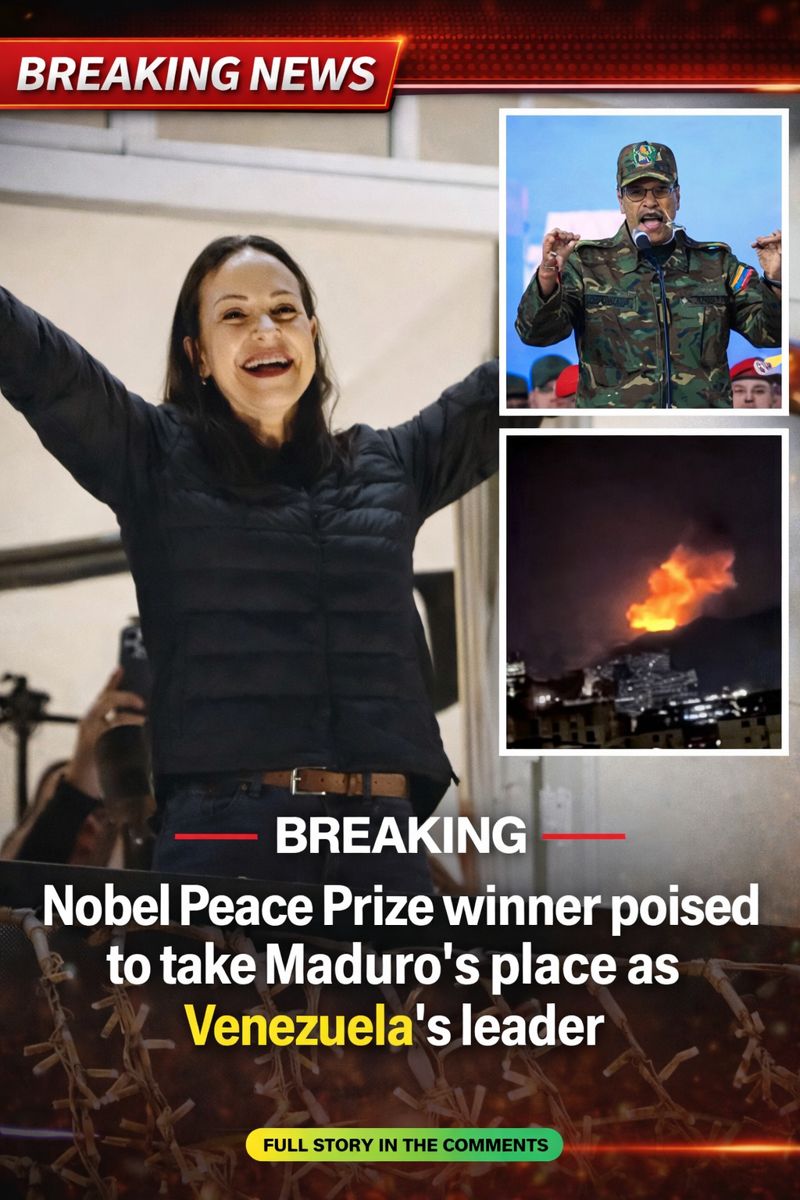
In the stunned silence that followed Nicolás Maduro’s capture and the U.S. airstrikes that illuminated the night sky over Venezuela’s capital, a different image began to crystallize in the public imagination. It was not one of explosions or military hardware, but of political symbolism: María Corina Machado, a Nobel medal resting at her throat, standing hand in hand with Edmundo González.
González is the man already recognized by Washington and a growing list of international governments as Venezuela’s legitimate president. Machado is the woman the Maduro-controlled courts attempted to erase from the electoral process—only to propel her, unintentionally, onto the global stage as the moral and political face of the opposition. Together, they now stand before a nation exhausted by years of economic collapse, rolling blackouts, mass exile, and an ever-present atmosphere of fear.
For many Venezuelans, the moment feels historic. After years of repression and stalled diplomacy, the collapse of Maduro’s grip has opened a narrow but powerful window for change. Yet the image of unity also masks the sheer scale of the challenge ahead. Any transitional government led by González and Machado would not be a victory lap or a simple transfer of power. It would be a high-stakes test of leadership in one of the most fractured societies in the Western Hemisphere.
The questions facing such a government are daunting. Can they reintegrate chavistas—millions of citizens who supported or depended on the previous system—back into civic life without pursuing vengeance or collective punishment? Can they dismantle authoritarian structures without triggering institutional collapse? Can they assert civilian authority over a military long accustomed to political privilege, while simultaneously calming street movements fueled by hunger, anger, and years of unfulfilled promises?
The economic wreckage alone is immense. Venezuela’s infrastructure has decayed after years of underinvestment, corruption, and sanctions. Power outages remain common, public services are fragile, and millions of citizens remain abroad, unsure whether it is safe—or even possible—to return. Restoring basic functionality will require not only international aid and debt restructuring, but also public trust in institutions that have been hollowed out for more than a decade.
Politically, the road is no less treacherous. A transitional administration would have to balance justice with stability, accountability with reconciliation. Too soft a touch risks legitimizing past abuses; too hard a line risks igniting backlash from entrenched interests, including factions within the security forces. The global spotlight that now elevates Machado and González also magnifies every misstep they might make.
For ordinary Venezuelans, hope has undeniably returned. Streets that once echoed with fear now carry cautious conversations about rebuilding and return. But alongside that hope sits a deep and lingering anxiety. Many remember previous moments when change seemed possible, only to collapse into deeper repression and hardship. There is a widespread understanding that failure this time could be catastrophic—ushering in not just disappointment, but a darker, more chaotic chapter than before.
What unfolds next will determine whether Venezuela’s long night finally gives way to durable renewal, or whether this moment becomes another painful chapter in a cycle of dashed expectations. For now, the country stands at a crossroads, watching two figures who symbolize resistance and legitimacy attempt something far harder than opposition: governing a wounded nation back toward the light.