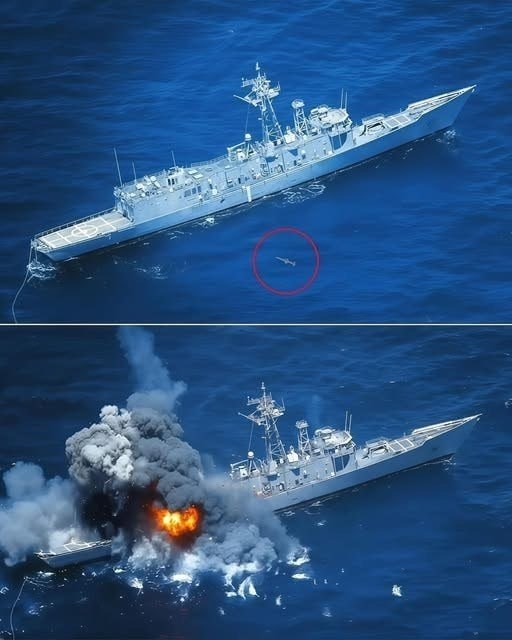
The former USS Rodney M. Davis (FFG-60), once an active guided-missile frigate of the United States Navy, met its final fate during a controlled SINKEX (sinking exercise) after being struck by an AGM‑84 Harpoon. Rather than being lost in combat, the vessel was intentionally sunk as part of a military training operation designed to test weapons systems and provide valuable tactical data. The exercise allowed naval forces to evaluate real-world strike capabilities while safely disposing of a retired warship that had already completed its operational service.
Commissioned in 1982, the ship belonged to the Oliver Hazard Perry-class frigate, a class developed during the height of the Cold War to strengthen naval defense against submarine threats and protect allied fleets. These frigates were specifically designed for anti-submarine warfare, convoy escort missions, and the protection of carrier battle groups. Equipped with advanced radar systems, missile launchers, and a flight deck capable of supporting naval helicopters, the class played a crucial role in maritime security for decades.
The vessel was named in honor of Rodney Maxwell Davis, a decorated Marine who was posthumously awarded the Medal of Honor for his heroic actions during the Vietnam War. His sacrifice and bravery made him a fitting namesake for a warship dedicated to protecting lives and maintaining stability at sea.
Throughout its decades of service, USS Rodney M. Davis participated in numerous deployments, multinational exercises, and maritime security operations across key strategic regions. The frigate frequently worked alongside allied navies, contributing to joint patrols, counter-piracy missions, and freedom-of-navigation operations aimed at maintaining stability along vital global shipping routes. Its presence supported coalition forces and reinforced the United States’ commitment to international maritime cooperation.
After years of reliable service, the ship was eventually decommissioned and selected as a target vessel for a SINKEX exercise. Such exercises serve an important purpose: they allow naval forces to practice live-fire scenarios against realistic targets while gathering data on weapons performance and ship survivability. The final sinking of USS Rodney M. Davis therefore represented not a loss, but the closing chapter of a long and productive career in naval service.
Even in its final moments, the vessel continued to serve a purpose—helping train future naval forces and contributing to the ongoing development of modern maritime warfare capabilities. Its legacy remains tied to decades of operational duty, international cooperation, and the enduring memory of the hero whose name it carried.