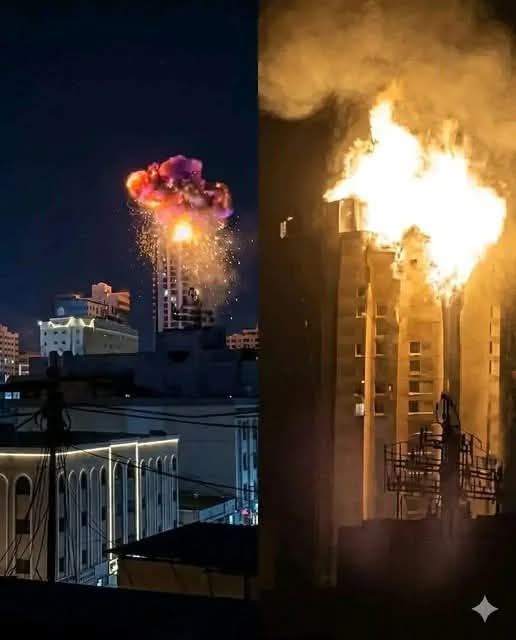
Tensions in the Persian Gulf have escalated sharply following multiple reports of coordinated attacks targeting United States military installations across the region. Iranian state television, citing military sources, announced that operations had been launched against US bases, marking a significant and potentially destabilizing development in an already volatile geopolitical landscape.
According to initial reports, Iranian forces have targeted several strategic locations in the Gulf, prompting immediate security responses from regional governments. Authorities in multiple countries have issued urgent advisories, calling on residents to remain indoors, avoid military zones, and follow official safety instructions as the situation continues to unfold.
In the United Arab Emirates, eyewitness accounts and international media reports, including Reuters, indicate that a powerful explosion was heard in Abu Dhabi. Shortly thereafter, Emirati authorities announced the closure of national airspace as a precautionary measure. Particular attention has been directed toward the Al Dhafra air base, a key military installation reportedly struck by Iranian ballistic missiles. The alleged impact triggered significant explosions, raising concerns about casualties and damage, though official confirmation remains limited.
Further north, in Bahrain’s capital Manama, reports have emerged of visible smoke in the Al Jufair district, an area known to host the headquarters of the US Navy’s Fifth Fleet. While details remain unclear, the development has intensified fears of a broader regional confrontation, with military and civilian authorities on heightened alert.
In Qatar, the Ministry of Interior has issued a shelter-in-place directive for residents following reports of a missile targeting the Al Udeid Air Base, one of the largest US military facilities in the region. Defense systems, including Patriot missile batteries, are said to have intercepted the incoming threat. As a precaution, Qatari authorities have also announced the closure of the country’s airspace, mirroring similar actions taken elsewhere in the Gulf.
The unfolding situation represents one of the most serious escalations in recent years, with multiple countries directly affected and critical infrastructure potentially at risk. While official confirmations and independent verifications are still ongoing, the scale and coordination suggested by these reports point to a rapidly evolving crisis with far-reaching implications.
International observers are closely monitoring developments, as any further escalation could significantly impact global security, energy markets, and diplomatic relations. Governments across the region continue to assess the situation in real time, urging calm while reinforcing defensive measures.
As more information becomes available, the full extent of the attacks—and their consequences—will become clearer. For now, the region remains on edge, with authorities prioritizing public safety and military readiness amid growing uncertainty.