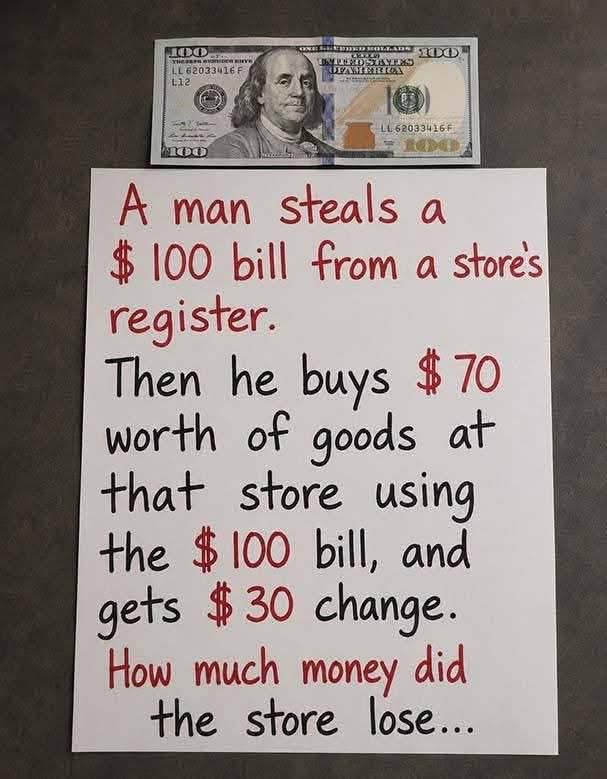
So, how much money did the store actually lose?
Give this some thought for a minute. Most people miss the boat completely on this puzzle because they try to treat the robbery and the shopping incident as two entirely different scenarios, when in reality all that needs to be done is follow the path of the money!

The real answer? The store lost exactly $100.
This is one of the simplest ways of looking at it if broken down into simple steps:
In the beginning, the store has both all of its stock and its money. Then comes the customer who steals $100 from the till. What has happened? The store has now been robbed of $100.
But that’s where everybody begins thinking too much about the problem.
Eventually, the criminal returns and spends that very same stolen hundred-dollar bill to buy seventy dollars’ worth of goods. Many individuals tend to think that the retailer has lost both the stolen cash and merchandise, but the accounting doesn’t work that way. Why? Since the stolen hundred-dollar bill is returned back to the cash register when the sale takes place. The retailer literally recovers its money.
Let us try to understand that in more detail:
Step 1: The Theft
The thief steals $100.
Damage: The loss on the part of the shop is $100. Simple enough.
Step 2: The Transaction
The thief comes back into the store and makes a purchase worth $70 using the exact same stolen money. The clerk unknowingly accepts it.
Once the deal is done, that $100 bill is back in the drawer, meaning the original cash is no longer missing. However, the store just handed the thief:
$70 worth of items
And $30 worth of cash.
Thus, the thief got $70 worth of goods and $30 in cash, totaling up to $100.

So, what did the store actually lose in the end? $70 in inventory plus $30 in change. Total loss: $100.
There is no loss of $200 in this case because you cannot count the same hundred dollar bill twice. Nor is there a loss of $170, because the stolen $100 was added back to the register. In the end, the only thing that has been lost is the merchandise plus the change, which comes to a total of precisely $100.
The problem lies not in calculating but rather in comprehending how the trick works. Our minds tend to consider the theft and the purchase completely separately despite the fact that they deal with exactly the same hundred dollar bill. The mind perceives “theft of money” along with “purchase of items,” and instantly comes up with an answer by adding both values together.
That’s why so many people confidently guess wrong on their first try. It’s a logic puzzle, not an arithmetic problem. People get tripped up by the idea of a crime and accidentally count the money twice, which is why online debates about this riddle get surprisingly intense. Even after hearing the fix, some people still fight it because the wording tricks them into thinking it’s more complicated than it is.

Look at it this way: if the thief had just walked in and magically left with $70 worth of stuff and $30 in cash, you’d instantly say the store lost $100. The whole “$100 bill” loop is just noise because it ended up right back where it started.
Once people see that, it clicks. Usually, that’s when they either laugh it off or get annoyed they didn’t catch it sooner. Riddles like this are great because they test your reasoning, not your math skills. You don’t need a calculator; you just have to look at the bottom line.
And no matter how you slice it, the bottom line is always the same: the store lost exactly $100.
Did you get it right on your first try?