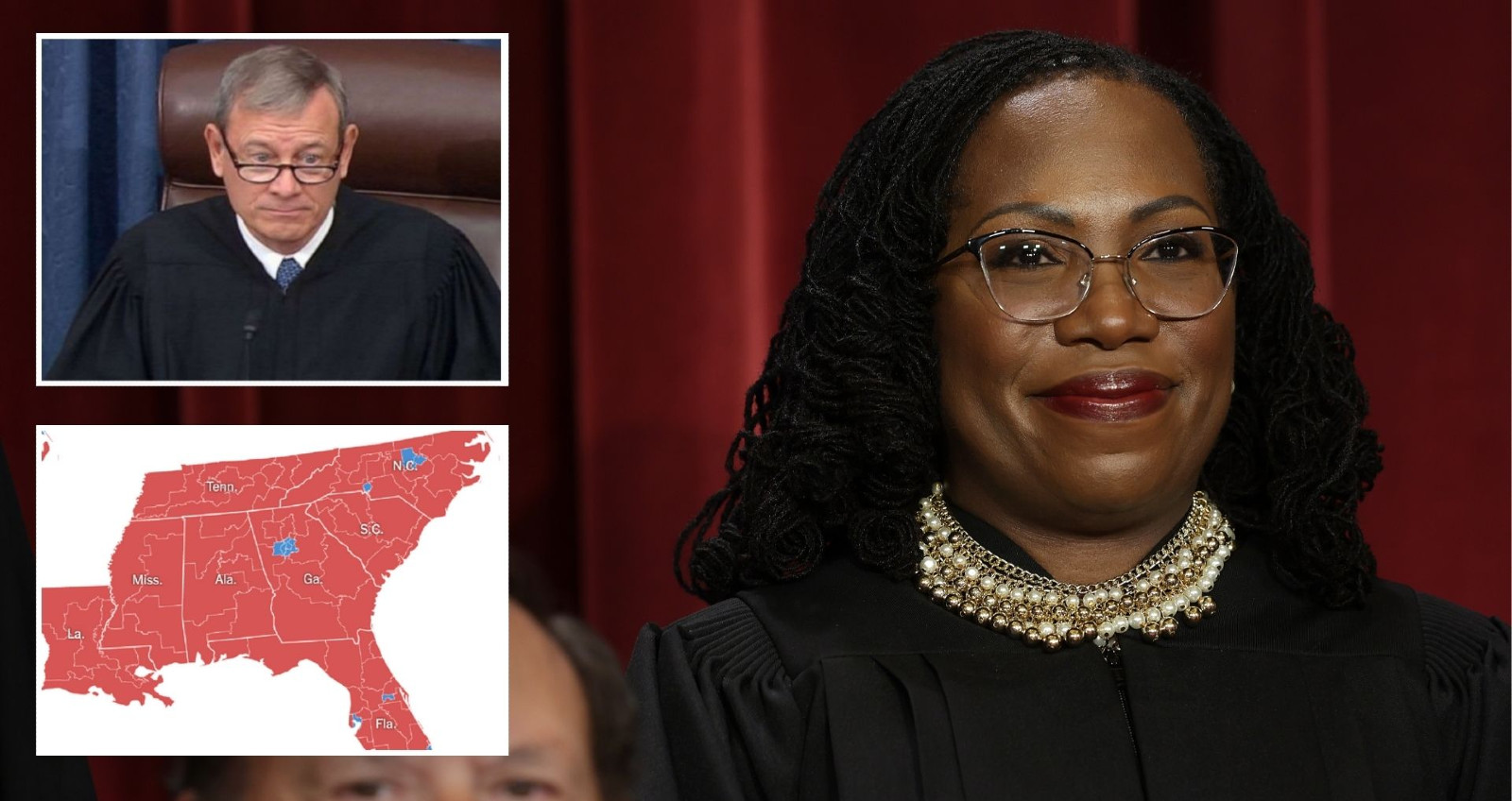
Justice Ketanji Brown Jackson is openly protesting the U.S. Supreme Court for ruling against racially gerrymandered districts.
Jackson, who was appointed by former President Joe Biden and literally speaks the most on the court, does not seem to understand why the nation’s highest court struck down racist gerrymandering.
Jackson protested against the Supreme Court’s choice to use their recent decision in a Louisiana gerrymandering case to tell lower courts how to interpret the Voting Rights Act, a move that could wipe out previous legal victories for voting rights groups.
After their decision in Louisiana v. Callais, in which they said race-based gerrymandering was wrong, the Supreme Court sent a Mississippi case back to the U.S. District Court “for further consideration” on Monday.
“This case presents only the question of Section 2’s private enforceability, which our decision in Louisiana v. Callais … did not address,” Jackson dissented, referencing Section 2 of the Voting Rights Act.
“Thus, I see no basis for vacating the lower court’s judgment,” she added.
In the case of Louisiana v. Callais, which came out last month, the Supreme Court limited the reach of section 2 of the Voting Rights Act. This part of the law limits how states can draw voting districts that affect black voters.
The main question in Louisiana v. Callais was whether Louisiana’s 2024 congressional plan, which added a second district with a majority of Black people, was an unconstitutional racial gerrymander.
According to the justices, following the Voting Rights Act can be a strong reason for redistricting by states. However, they agreed with the lower court that Louisiana did not need to create a second district with mostly Black voters.
The U.S. Supreme Court struck down Louisiana’s congressional map and sharply limited the use of race in drawing district boundaries in a major ruling that could carry significant consequences for future House elections.
In comparison to 2024 maps, the decision could increase the Republican dominance in the House by an extra 19 seats and alter voting throughout the South.
Louisiana had been ordered by lower courts to create a second majority-Black congressional district in 2024 to comply with Section 2 of the 1965 Voting Rights Act, which bars states from diluting minority voting strength.
The Trump administration and state officials challenged the revised map, arguing it amounted to an unconstitutional racial gerrymander in violation of the 14th Amendment, which guarantees equal protection under the law, reports said.
In a majority opinion, Justice Samuel Alito said that “because the Voting Rights Act did not require Louisiana to create an additional majority-minority district, no compelling interest justified the State’s use of race in creating SB8, and that map is an unconstitutional racial gerrymander.”
About one-third of Louisiana’s residents are African-American, and the state’s only two Democratic lawmakers in Congress (compared to four House Republicans) were elected from majority-black districts.
The ruling carries immense weight, with two prominent voting rights organizations noting earlier that the removal or restriction of Section 2 will likely empower Republican-led legislatures to change the boundaries of as many as 19 congressional districts to their advantage, in order to comply with the court.
“However, it’s not clear if red states will be able to seize on the Supreme Court’s decision in time to significantly impact the 2026 midterms, in which Democrats are favored to retake the House of Representatives,” the New York Post reported.
This would enable mapmakers to emphasize Republican strengths.
Voting rights organizations aligned with the Democratic Party already warned that the removal or restriction of Section 2 could empower Republican-led legislatures to change the boundaries of as many as 19 congressional districts to their advantage.
Fair Fight Action and the Black Voters Matter Fund argue that if Section 2 of the Voting Rights Act is invalidated, it could significantly increase the likelihood that Republicans will maintain control of the House of Representatives for years.
Research has identified 27 congressional seats nationwide that Republicans could benefit from if the current legal and political landscape remains unchanged.
Nineteen of these changes are directly tied to the potential loss of Section 2 protections.
The SCOTUS ruling will prompt many states to redraw maps ahead of November’s elections.
On Friday, the Virginia Supreme Court struck down a Democrat-inspired gerrymandered congressional map that would have given the party four of the five seats currently held by Republicans in a state that is about as evenly divided as any in the country.