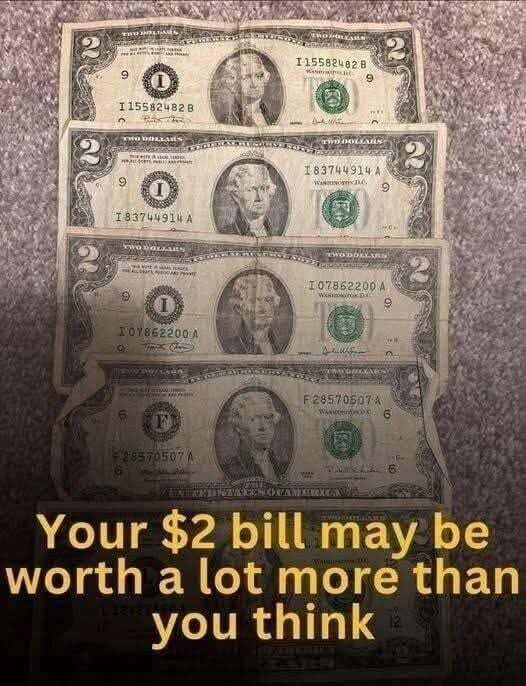
For generations, the $2 bill has been surrounded by mystery, folklore, and misconceptions. At various points in American history, some superstitious individuals believed the bill carried bad luck or even a curse. Stories circulated claiming that possessing or spending a $2 bill could bring misfortune, leading many people to avoid it altogether. Yet despite these long-standing myths, the reality is far different. Rather than being a symbol of bad fortune, the $2 bill may actually prove to be a lucky discovery—especially for collectors and curious owners who understand its potential value.
Often overshadowed by the far more familiar $1 bill, the $2 note has earned a reputation as the overlooked member of American currency. Many Americans rarely encounter one in daily life, which has fueled the widespread belief that the denomination is either extremely rare or no longer in circulation. This misunderstanding has only strengthened the bill’s unusual and somewhat mysterious image over the years.
The history of the $2 bill dates back to the 19th century, when it was first introduced as part of the nation’s growing monetary system. Over time, the note featured several redesigns and became associated with various cultural myths and misunderstandings. Some people refused to accept it in transactions, while others viewed it with suspicion simply because they were unfamiliar with seeing it in regular circulation.
Contrary to popular belief, the $2 bill has never been officially discontinued. The U.S. Treasury continues to print $2 notes, and they remain legal tender alongside all other American currency. However, because relatively few are requested by banks and because many people choose to keep them as souvenirs or collector’s items rather than spend them, they appear far less frequently in everyday transactions. This limited visibility often leads people to mistakenly assume the bills are no longer produced.
Part of the fascination surrounding the $2 bill comes from its unique design and historical significance. The front of the note features President Thomas Jefferson, while the reverse commonly displays a depiction inspired by the signing of the Declaration of Independence. These distinctive features help set the bill apart from more commonly circulated denominations and contribute to its appeal among history enthusiasts and collectors alike.
If you happen to come across a $2 bill tucked inside an old wallet, stored in a family keepsake box, or handed to you in change, experts suggest taking a closer look before spending it. While many $2 bills are worth exactly their face value, certain editions can command significantly higher prices in the collectors’ market.
Bills printed during specific years, those produced in limited quantities, or examples with unusual characteristics may be particularly valuable. Collectors often seek out notes with low serial numbers, repeating digits, star notes, printing errors, or other distinctive markings that set them apart from ordinary circulation bills. Depending on rarity and condition, some $2 bills have sold for hundreds—and in certain cases, even thousands—of dollars.
Condition also plays an important role in determining value. Bills that remain crisp, clean, and well-preserved generally attract greater interest from collectors than heavily worn or damaged examples. Because of this, experts recommend handling potentially valuable notes carefully and considering professional evaluation if a bill appears especially unusual or historically significant.
What was once dismissed as an unlucky or unwanted piece of currency has, over time, become a fascinating part of American monetary history. The $2 bill continues to spark curiosity, challenge old myths, and remind people that sometimes the most overlooked items can hold surprising stories—and occasionally, unexpected value.