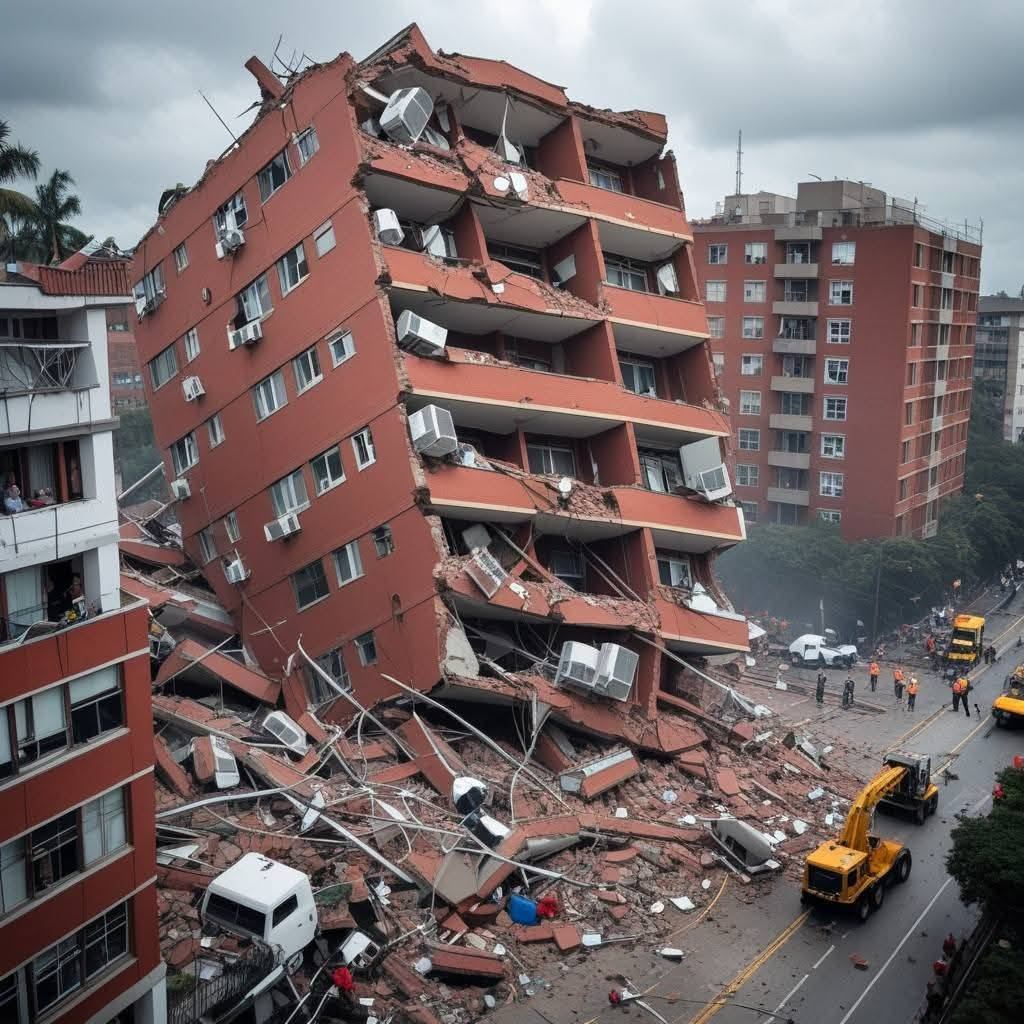
A powerful earthquake has struck central Colombia, causing widespread damage across several urban areas and leaving emergency services engaged in urgent search-and-rescue operations. The most severe structural impact was reported in downtown Bogotá, where a multi-story residential building suffered a partial collapse, tilting heavily against an adjacent structure and raising immediate fears of further instability.
Authorities have confirmed that multiple fatalities have occurred, with dozens of additional people injured. Rescue teams also report that a significant number of residents may still be trapped beneath collapsed sections of the building, prompting an ongoing and highly coordinated emergency response.
The seismic event was recorded at a magnitude of 6.3 on the Richter scale, with its epicenter located near Villavicencio, roughly 80 kilometers southeast of the capital. The earthquake struck at approximately 10:47 AM local time and lasted close to 45 seconds—an unusually prolonged duration for a tremor of this strength. The shockwaves were felt across a wide region, including major cities such as Medellín and Cali, where buildings swayed and residents evacuated into open spaces.
In the most heavily affected areas of Bogotá, the scale of destruction is severe. Structural failures are visible throughout the compromised apartment complex, with multiple floors showing signs of collapse. Balconies have crumbled away from the façade, exterior walls are fractured, and sections of concrete have given way entirely. Loose air-conditioning units and exposed steel reinforcements hang precariously from damaged sections of the structure, underscoring the risk of secondary collapse.
On the streets below, debris from the building is scattered across vehicles and sidewalks, while dust continues to linger in the air. Emergency responders, including firefighters, paramedics, and urban search-and-rescue teams, are working in difficult and unstable conditions. Heavy machinery has been deployed to assist with clearing debris, while teams on foot carefully navigate the wreckage in search of survivors.
Command units on-site are coordinating evacuation zones and restricting access to surrounding blocks to ensure public safety and allow uninterrupted rescue operations. Hospitals across Bogotá have activated emergency protocols in anticipation of additional casualties, while medical teams prepare to treat both physical injuries and trauma-related conditions.
The situation remains fluid as aftershocks continue to pose a risk to already weakened structures. Officials have urged residents to remain in safe areas and avoid returning to damaged buildings until structural assessments are completed.
As search efforts continue, attention remains focused on locating survivors and stabilizing critical infrastructure. The full extent of the damage is still being assessed, but early reports indicate significant impact across both residential and commercial zones.
The priority, according to emergency authorities, remains clear: saving lives, stabilizing affected structures, and maintaining control in an environment still defined by uncertainty and ongoing seismic risk.